>
Cypriniformes (Carps) >
Gobionidae (Gudgeons)
Etymology: Abbottina: Named for James Francis Abbott, formerly a professor in the Japanese Military Academy at Etajima, who assisted Professors Jordan and Snyder in their work on Lake Biwa, Lake Yogb, Yodo River, and at Tsuruga and Misaki (D. Hollombe, pers.comm., 2014 November).
Eponymy: Dr James Francis Abbott (1876–1926) was an American zoologist who also became a diplomat and a special adviser on Japanese affairs. [...] (Ref. 128868), visit book page.
Environnement : milieu / zone climatique / profondeur / gamme de distribution
Écologie
; eau douce; saumâtre benthopélagique. Subtropical
Asia: originally eastern China, Korea and Japan. Introduced in the Mekong basin (Ref. 43281). Recorded from Tedzhen River basin in Turkmenistan (Ref. 39702).
Longueur à la première maturité / Taille / Poids / Âge
Maturité: Lm 4.5, range 4 - 5 cm
Max length : 18.9 cm TL mâle / non sexé; (Ref. 89110)
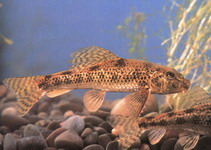
Lower lip continuous, with two median lobes along its posterior margin, separated by a median furrow (Ref. 43281). No papilla on lips. One pair of short maxillary barbels. Anus close to ventral-fin base than to anal-fin base. Body with eight rounded dusky blotches along lateral line (Ref. 12819). Mouth inferior; dorsal with convex distal margin; several vertical rows of black dots on caudal (Ref. 43281).
Body shape (shape guide): fusiform / normal.
Adults inhabit shallow zones of lentic rivers and lakes with sandy or muddy bottoms (Ref. 12819).
Cycle de vie et comportement reproducteur
Maturité | Reproduction | Frai | Œufs | Fécondité | Larves
The male builds a nest 12-43 cm in diameter on the bottom of the river, at a depth of 8-34 cm, and broods over the spawn. 1,711 eggs were found in a single nest (Ref. 1441).
Masuda, H., K. Amaoka, C. Araga, T. Uyeno and T. Yoshino, 1984. The fishes of the Japanese Archipelago. Vol. 1. Tokai University Press, Tokyo, Japan. 437 p. (text). (Ref. 559)
Statut dans la liste rouge de l'IUCN (Ref. 130435: Version 2025-2 (Global))
Menace pour l'homme
Harmless
Utilisations par l'homme
Pêcheries: pêcheries vivrières
Outils
Articles particuliers
Télécharger en XML
Sources Internet
Estimations basées sur des modèles
Indice de diversité phylogénétique (Réf.
82804): PD
50 = 0.5312 [Uniqueness, from 0.5 = low to 2.0 = high].
Bayesian length-weight: a=0.00776 (0.00645 - 0.00934), b=3.14 (3.09 - 3.19), in cm total length, based on LWR estimates for this species (Ref.
93245).
Niveau trophique (Réf.
69278): 3.3 ±0.4 se; based on size and trophs of closest relatives
Generation time: 3.7 ( na - na) years. Estimated as median ln(3)/K based on 1
growth studies.
Résilience (Réf.
120179): Milieu, temps minimum de doublement de population : 1,4 à 4,4 années (Preliminary K or Fecundity.).
Vulnérabilité de la pêche (Ref.
59153): Low to moderate vulnerability (33 of 100).
🛈