>
Albuliformes (Bonefishes) >
Albulidae (Bonefishes) > Pterothrissinae
Etymology: Nemoossis: Name from Latin words 'Nemo' meaning absence and 'ossis' for bones; referring to the absence of supraneural bones.
Eponymy: Gérard Belloc was Directeur du Laboratoire de l’Office Scientifique et Technique des Pêches Maritimes at La Rochelle (1920s & 1930s). [...] (Ref. 128868), visit book page.
Environnement : milieu / zone climatique / profondeur / gamme de distribution
Écologie
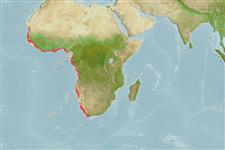
marin bathydémersal; profondeur 20 - 500 m (Ref. 3545), usually 100 - 400 m (Ref. 5576). Deep-water; 22°N - 35°S, 18°W - 20°E (Ref. 109573)
Eastern Atlantic: from Senegal to the west coast of South Africa
Taille / Poids / Âge
Maturité: Lm ? range ? - ? cm
Max length : 40.0 cm SL mâle / non sexé; (Ref. 5576); common length : 33.0 cm SL mâle / non sexé; (Ref. 5576)
Description synthétique
Clés d'identification | Morphologie | Morphométrie
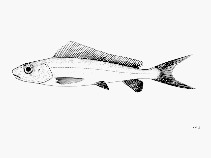
Épines dorsales (Total) : 0; Rayons mous dorsaux (Total) : 51 - 57; Épines anales: 0; Rayons mous anaux: 11 - 13; Vertèbres: 88 - 92. This species is distinguished by the following set of characters (counts & % in parentheses for lectotype): no supraneural bones; dorsal-fin rays 51-57 (mode 52); total vertebrae 88-92 (91); pored lateral-line scales 79-89 (84); pre-dorsal scale rows 3-8 (8); head length 24-32 % (mean 30 %) of SL); pectoral-fin length 16-21 % (19 %) of SL; pre-dorsal-fin length 27-34 % (30 %) of SL; dorsal-fin base length 53-64 % (60 %) of SL; postorbital length 13-16 % (14 %) of SL; upper caudal-fin length 18-31 % (24 %) of SL (Ref. 109573).
Body shape (shape guide): elongated; Cross section: oval.
Common on the continental slope (Ref. 2683). Found on muddy bottoms (Ref. 27121). Feeds on benthic copepods and polychaetes (Ref. 27637).
Cycle de vie et comportement reproducteur
Maturité | Reproduction | Frai | Œufs | Fécondité | Larves
Spawning occurs in open waters. Eggs are pelagic (Ref. 205).
Hidaka, K., Y. Tsukamoto and Y. Iwatsuki, 2017. Nemoossis, a new genus for the eastern Atlantic long-fin bonefish Pterothrissus belloci Cadenat 1937 and a redescription of P. gissu Hilgendorf 1877 from the northwestern Pacific. Ichthyol. Res. 64:45-53. (Ref. 109573)
Statut dans la liste rouge de l'IUCN (Ref. 130435: Version 2025-2 (Global))
Menace pour l'homme
Harmless
Utilisations par l'homme
Pêcheries: intérêt commercial mineur
Outils
Articles particuliers
Télécharger en XML
Sources Internet
Estimations basées sur des modèles
Température préférée (Réf.
123201): 8.8 - 16, mean 13.9 °C (based on 56 cells).
Indice de diversité phylogénétique (Réf.
82804): PD
50 = 1.0002 [Uniqueness, from 0.5 = low to 2.0 = high].
Bayesian length-weight: a=0.00513 (0.00202 - 0.01305), b=3.09 (2.87 - 3.31), in cm total length, based on LWR estimates for this (Sub)family-body shape (Ref.
93245).
Niveau trophique (Réf.
69278): 3.0 ±0.17 se; based on food items.
Résilience (Réf.
120179): Milieu, temps minimum de doublement de population : 1,4 à 4,4 années (Assuming tm=3-4).
Vulnérabilité de la pêche (Ref.
59153): Moderate vulnerability (39 of 100).
🛈
Vulnérabilité climatique (Ref.
125649): Low to moderate vulnerability (28 of 100).
🛈
Nutriments (Ref.
124155): Calcium = 37.5 [22.5, 83.1] mg/100g; Iron = 0.516 [0.256, 0.988] mg/100g; Protein = 16.7 [15.5, 17.9] %; Omega3 = 0.288 [0.144, 0.587] g/100g; Selenium = 21.1 [8.6, 50.6] μg/100g; VitaminA = 8.08 [1.57, 37.34] μg/100g; Zinc = 0.476 [0.318, 0.698] mg/100g (wet weight);