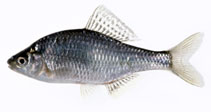
Environnement : milieu / zone climatique / profondeur / gamme de distribution
Écologie
; eau douce; saumâtre benthopélagique; profondeur ? - 40 m (Ref. 78070). Temperate; 10°C - 25°C (Ref. 13614)
Asia: Japan. Five subspecies were recognized: Acheilognathus tabira erythropterus Pacific Ocean side of eastern Honshu (Miyagi, Tochigi, Ibaraki, Chiba Prefectures and Tokyo Metropolis); Acheilognathus tabira jordani in Japan Sea side of western Honshu (Toyama, Ishikawa, Fukui, Tottori and Shimane Prefectures); Acheilognathus tabira nakamurae in Kyushu area; Acheilognathus tabira tabira in Western Honshu; and Acheilognathus tabira tohokuensis in Japan Sea side of eastern Honshu (Akita, Yamagata, Fukushima in western area and Niigata Prefectures).
Taille / Poids / Âge
Maturité: Lm ? range ? - ? cm
Max length : 7.9 cm SL mâle / non sexé; (Ref. 78070)
Rayons mous dorsaux (Total) : 11 - 14; Rayons mous anaux: 11 - 13; Vertèbres: 35 - 38. Can be diagnosed by having the following characters: dorsal fin with iii, 9-11 rays; anal fin with iii, 9-10 rays; dorsal fin in males grayish; anal fin in nuptial males white; absence of black blotch on dorsal fin in juveniles; eggs short ellipsoid, ratio of major axis to minor axis, 1.4-1.7 (Ref. 78070).
Body shape (shape guide): fusiform / normal.
Inhabits rivers, creeks, lakes and ponds in plains. Also occurs in mouths of rivers draining into lagoons, in rocky shores of rivers and irrigation creeks, and in floodplain pools. Deposits its eggs into host mussels (Ref. 78070).
Cycle de vie et comportement reproducteur
Maturité | Reproduction | Frai | Œufs | Fécondité | Larves
Female has an ovipositor which is used to deposit eggs inside bivalves. Young remain in the bivalve until they can swim (Ref. 43281).
Doi, A., R. Arai and H.-Z. Liu, 1999. Acheilognathus macromandibularis, a new bitterling (Cyprinidae) from the lower Changjiang basin, China. Ichthyol. Explor. Freshwat. 10(4):303-308. (Ref. 39330)
Statut dans la liste rouge de l'IUCN (Ref. 130435: Version 2025-2 (Global))
Menace pour l'homme
Harmless
Utilisations par l'homme
Outils
Articles particuliers
Télécharger en XML
Sources Internet
Estimations basées sur des modèles
Indice de diversité phylogénétique (Réf.
82804): PD
50 = 0.5000 [Uniqueness, from 0.5 = low to 2.0 = high].
Bayesian length-weight: a=0.01096 (0.00507 - 0.02372), b=3.10 (2.93 - 3.27), in cm total length, based on LWR estimates for this Genus-body shape (Ref.
93245).
Niveau trophique (Réf.
69278): 2.2 ±0.1 se; based on size and trophs of closest relatives
Résilience (Réf.
120179): Milieu, temps minimum de doublement de population : 1,4 à 4,4 années (Assuming Fec < 10,000).
Vulnérabilité de la pêche (Ref.
59153): Low vulnerability (10 of 100).
🛈