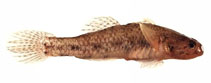
>
Gobiiformes (Gobies) >
Gobiidae (Gobies) > Gobionellinae
Etymology: Pseudogobius: Greek, pseudes = false + Latin, gobius = gudgeon (Ref. 45335).
More on author: Sauvage.
Environnement : milieu / zone climatique / profondeur / gamme de distribution
Écologie
; eau douce; saumâtre démersal; amphidrome (Ref. 138269); profondeur 0 - 3 m (Ref. 126575). Subtropical
Oceania: south-western Australia.
Taille / Poids / Âge
Maturité: Lm ? range ? - ? cm
Max length : 6.0 cm SL mâle / non sexé; (Ref. 5259); common length : 4.0 cm SL mâle / non sexé; (Ref. 5259)
Facultative air-breathing in the genus (Ref. 126274); Found in freshwater streams and ponds and brackish estuaries. Usually over mud and rock bottoms, sometimes among weeds (Ref. 44894). Feeds mainly on insects, crustaceans and algae. Spawns during spring in the upper reaches of estuaries (in less than 30% salinity), where aquatic vegetation is plentiful (Ref. 44894).
Cycle de vie et comportement reproducteur
Maturité | Reproduction | Frai | Œufs | Fécondité | Larves
Female lays up to 150 eggs on the underside of a solid object such as a rock, can or other debris. Male guards and fans the eggs during the incubation period, which lasts about 4 days.
Larson, H.K. and M.P. Hammer, 2021. A revision of the gobiid fish genus Pseudogobius (Teleostei, Gobiidae, Tridentigerinae), with description of seven new species from Australia and South-east Asia. Zootaxa 4961(1):1-85. (Ref. 126575)
Statut dans la liste rouge de l'IUCN (Ref. 130435: Version 2025-2 (Global))
Menace pour l'homme
Harmless
Utilisations par l'homme
Outils
Articles particuliers
Télécharger en XML
Sources Internet
Estimations basées sur des modèles
Indice de diversité phylogénétique (Réf.
82804): PD
50 = 0.5000 [Uniqueness, from 0.5 = low to 2.0 = high].
Bayesian length-weight: a=0.00708 (0.00332 - 0.01511), b=3.07 (2.89 - 3.25), in cm total length, based on LWR estimates for this (Sub)family-body shape (Ref.
93245).
Niveau trophique (Réf.
69278): 2.9 ±0.36 se; based on food items.
Résilience (Réf.
120179): Haut, temps minimum de doublement de population inférieur à 15 mois (tm<1).
Vulnérabilité de la pêche (Ref.
59153): Low vulnerability (10 of 100).
🛈