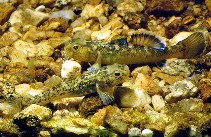
>
Gobiiformes (Gobies) >
Gobiidae (Gobies) > Gobionellinae
Etymology: Chlamydogobius: Greek, chlamys, -idos = cloak, cape + Latin, gobius = gudgeon (Ref. 45335).
Ambiente: milieu / zona climática / intervalo de profundidade / gama de distribuição
Ecologia
; Água doce demersal; pH range: 7.0 - 8.0; dH range: 9 - 19. Temperate; 10°C - 35°C (Ref. 2060), 136°E - 137°E
Oceania: South Australia, Australia.
Tamanho / Peso / Idade
Maturidade: Lm ? range ? - ? cm
Max length : 6.0 cm TL macho/indeterminado; (Ref. 5259)
Facultative air-breathing (Ref. 126274); Occurs in pools and streams associated with artesian springs and bores (Ref. 5259, 44894). Lives in shaded areas around plants or rocks (Ref. 44894). Found in harsh environment characterized by rapid fluctuations in temperature and salinity (Ref. 5259, 44894). Field observations and laboratory experimentation indicate that it can withstand wide ranges of temperature (5°-41°C), salinity (0-60 p.p.t.), pH (6.8-11.0) and very low dissolved oxygen level (Ref. 44894). Feeds on insects, crustaceans, filamentous algae and detritus (Ref. 5259).
Female deposits eggs on the ceiling of a rocky crevice. Male guards the nest until hatching, which requires 10 to 17 days at temperatures ranging from 27°-30° C.
Larson, H.K., 2001. A revision of the gobiid fish genus Mugilogobius (Teleostei: Gobioidei), and its systematic placement. Rec. West. Aust. Mus. (Suppl. No. 62):1-233. (Ref. 43716)
Categoria na Lista Vermelha da IUCN (Ref. 130435: Version 2025-2 (Global))
Ameaça para o homem
Harmless
Utilização humana
Ferramentas
Relatórios especiais
Descarregue XML
Fontes da internet
Estimativas baseadas em modelos
Índice de diversidade filogenética (Ref.
82804): PD
50 = 0.5156 [Uniqueness, from 0.5 = low to 2.0 = high].
Bayesian length-weight: a=0.00708 (0.00332 - 0.01511), b=3.07 (2.89 - 3.25), in cm total length, based on LWR estimates for this (Sub)family-body shape (Ref.
93245).
Nível Trófico (Ref.
69278): 2.7 ±0.31 se; based on food items.
Resiliência (Ref.
120179): Elevada, tempo mínimo de duplicação da população menor que 15 meses (tm=0.5; Fec=20-250; assuming multiple spawning).
Vulnerabilidade da pesca (Ref.
59153): Low vulnerability (10 of 100).
🛈