>
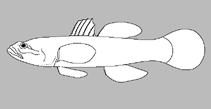
Gobiiformes (Gobies) >
Eleotridae (Bully sleepers)
Etymology: Philypnodon: Greek, phyleo = to like + Greek, ypnos = excrement + Greek, odous = teeth.
Entorno: milieu / zona climática / rango de profundidad / gama de distribución
Ecología
; agua dulce; salobre demersal. Subtropical
Oceania: endemic to Australia.
Tamaño / Peso / Edad
Madurez: Lm ? range ? - ? cm
Max length : 12.0 cm TL macho / no sexado; (Ref. 5259); common length : 8.0 cm TL macho / no sexado; (Ref. 5259)
Found in still and flowing waters; often abundant in dams and lakes, usually among weeds or over mud bottoms. Occurs in reservoirs and brackish estuaries, less common in gently flowing streams (Ref. 44894). Feeds on crustaceans, insects, other fishes and tadpoles (Ref. 44894). In breeding season (mainly spring to summer), males darken and display more vibrant fin markings. Females lay a clutch of eggs on a hard surface such as a rock or piece of wood. The male cares for the nest, chasing away intruders and fanning the eggs with his pectoral fins. Hatching occurs after 4-6 days (Ref. 44894).
Ciclo vital y comportamiento de apareamiento
Madurez | Reproducción | Puesta | Huevos | Fecundidad | Larva
Allen, G.R., 1989. Freshwater fishes of Australia. T.F.H. Publications, Inc., Neptune City, New Jersey. (Ref. 5259)
Situación en la Lista Roja de la UICN (Ref. 130435: Version 2025-2 (Global))
Amenaza para el ser humano
Harmless
Usos humanos
Herramientas
Informes especiales
Descargar XML
Fuentes de Internet
Estimaciones basadas en modelos
Índice de diversidad filogenética (Referencia
82804): PD
50 = 0.7500 [Uniqueness, from 0.5 = low to 2.0 = high].
Bayesian length-weight: a=0.00741 (0.00323 - 0.01701), b=3.13 (2.94 - 3.32), in cm total length, based on LWR estimates for this (Sub)family-body shape (Ref.
93245).
Nivel trófico (Referencia
69278): 3.8 ±0.59 se; based on food items.
Resiliencia (Referencia
120179): Alto, población duplicada en un tiempo mínimo inferior a 15 meses (Preliminary K or Fecundity.).
Vulnerabilidad pesquera (Ref.
59153): Low vulnerability (10 of 100).
🛈