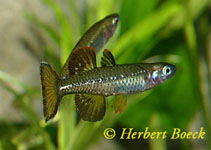
Environnement : milieu / zone climatique / profondeur / gamme de distribution
Écologie
; eau douce démersal. Tropical; 25°C - 35°C (Ref. 5259); 8°S - 16°S
Oceania: Australia and southern Papua New Guinea.
Taille / Poids / Âge
Maturité: Lm ? range ? - ? cm
Max length : 5.5 cm SL mâle / non sexé; (Ref. 44894); common length : 4.0 cm SL mâle / non sexé; (Ref. 44894)
Épines dorsales (Total) : 3 - 5; Rayons mous dorsaux (Total) : 6 - 7; Épines anales: 0; Rayons mous anaux: 7 - 10.
Body shape (shape guide): fusiform / normal.
Inhabits swamps and quiet backwaters of streams with mud or gravel bottoms and abundant vegetation including water lilies. Usually found in waters exposed to full sunlight (Ref. 2847, 44894). Occurs in marshy ponds (billabongs), overflow pools of rivers and creeks (Ref. 44894) Occurs at temperatures ranging from 25°-35° C. Possibly more widespread, but has escaped detection due to its small size and inconspicuous appearance (Ref. 44894).
Cycle de vie et comportement reproducteur
Maturité | Reproduction | Frai | Œufs | Fécondité | Larves
Allen, G.R., 1989. Freshwater fishes of Australia. T.F.H. Publications, Inc., Neptune City, New Jersey. (Ref. 5259)
Statut dans la liste rouge de l'IUCN (Ref. 130435: Version 2025-2 (Global))
Menace pour l'homme
Harmless
Utilisations par l'homme
Outils
Articles particuliers
Télécharger en XML
Sources Internet
Estimations basées sur des modèles
Indice de diversité phylogénétique (Réf.
82804): PD
50 = 0.5000 [Uniqueness, from 0.5 = low to 2.0 = high].
Bayesian length-weight: a=0.01122 (0.00514 - 0.02450), b=3.04 (2.87 - 3.21), in cm total length, based on all LWR estimates for this body shape (Ref.
93245).
Niveau trophique (Réf.
69278): 3.4 ±0.4 se; based on size and trophs of closest relatives
Vulnérabilité de la pêche (Ref.
59153): Low vulnerability (10 of 100).
🛈