>
Atheriniformes (Silversides) >
Atherinidae (Silversides) > Craterocephalinae
Etymology: Craterocephalus: Greek, krater, -eros = bowl, mixing vessel + Greek, kephale = head (Ref. 45335).
More on author: Whitley.
Ambiente: milieu / zona climatica / distribuzione batimetrica / gamma di distribuzione
Ecologia
; acqua dolce benthopelagico; pH range: 7.0 - ? ; dH range: 12 - ?. Tropical; 25°C - 30°C (Ref. 2060)
Oceania: endemic to Australia.
Dimensione / Peso / Età
Maturità: Lm ? range ? - ? cm
Max length : 6.5 cm SL maschio/sesso non determinato; (Ref. 44894); common length : 4.0 cm SL maschio/sesso non determinato; (Ref. 44894)
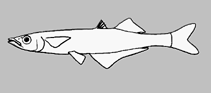
Distinguished from all other species of that genus by a combination of the following: greatest body depth 3.1-4.1 (3.8); least body depth 8.0-9.9 (9.2); origin of pectoral to anus 2.8-3.1 (3.0), all in SL. Eye 2.6-3.5 (2.9) in head. Dorsal process of premaxilla 1.4-2.2 (1.8) in eye. Lips in premaxilla 2.6-3.7 (3.1). Predorsal scales 10-12 (10.9). Origin of first dorsal from one scale behind to 2.5 scales in front of tip of pectoral fin (Table 1). Unique in dentition and length of spines in first dorsal fin. Differs osteologically from other members of the genus by a combination of the following: shape of premaxilla and maxilla; lateral ramus of premaxilla with greatly reduced secondary process; shape of nasal bone; and with basibranchial toothplate present. Differs genetically from other species only in allele frequencies at the following loci: FUM, MDH and MPI (Ref. 26703).
Body shape (shape guide): elongated.
Occurs in clear, flowing streams, as well as in still water. Found in well-vegetated stream and lake margins. Forms moderate-sized shoals, swimming just below the surface (Ref. 44894). Feeds on insects and their larvae, small crustaceans, snails and some algae. Although attractive, they are delicate and usually difficult to maintain in captivity (Ref. 44894).
Ciclo vitale e comportamento di accoppiamento
Maturità | Riproduzione | Deposizione | Uova | Fecondità | Larve
Crowley, L.E.L.M. and W. Ivantsoff, 1992. Redefinition of the freshwater fish genus Craterocephalus (Teleostei: Atherinidae) of Australia and New Guinea with an analysis of three species. Ichthyol. Explor. Freshwat. 3(3):273-287. (Ref. 26703)
Stato della Lista Rossa IUCN (Ref. 130435: Version 2025-2 (Global))
Minaccia per l'uomo
Harmless
Usi umani
Strumenti
Rapporti speciali
Scarica XML
Fonti Internet
Stime basate su modelli
Indice di diversità filogenetica (Fonte Biblio.
82804): PD
50 = 0.5000 [Uniqueness, from 0.5 = low to 2.0 = high].
Bayesian length-weight: a=0.00389 (0.00180 - 0.00842), b=3.12 (2.94 - 3.30), in cm total length, based on all LWR estimates for this body shape (Ref.
93245).
Livello trofico (Fonte Biblio.
69278): 3.0 ±0.40 se; based on food items.
Resilienza (Fonte Biblio.
120179): Alto, tempo minimo di raddoppiamento della popolazione meno di 15 mesi (Preliminary K or Fecundity.).
Vulnerabilità della pesca (Ref.
59153): Low vulnerability (10 of 100).
🛈
Nutrienti (Ref.
124155): Calcium = 328 [126, 752] mg/100g; Iron = 1.54 [0.79, 2.81] mg/100g; Protein = 18.4 [16.1, 20.7] %; Omega3 = 0.358 [0.108, 1.248] g/100g; Selenium = 30.5 [10.6, 85.0] μg/100g; VitaminA = 152 [47, 424] μg/100g; Zinc = 3.54 [2.29, 5.27] mg/100g (wet weight);