>
Anguilliformes (Eels and morays) >
Ophichthidae (Snake eels) > Ophichthinae
Etymology: Brachysomophis: Greek, brachys, eia = short + Greek, soma = body + Greek, ophis = serpent (Ref. 45335); porphyreus: Named for its purplish (= porphyreus) coloration when alive.
More on authors: Temminck & Schlegel.
Environnement : milieu / zone climatique / profondeur / gamme de distribution
Écologie
marin démersal; profondeur ? - 20 m (Ref. 42180). Temperate
Northwest Pacific: Taiwan and the southern coasts of China and Japan.
Taille / Poids / Âge
Maturité: Lm ? range ? - ? cm
Max length : 130 cm TL mâle / non sexé; (Ref. 42180)
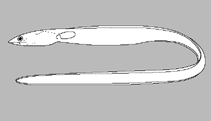
Vertèbres: 137 - 148. This species is distinguished by the following characters: tail 52% and head 11-14% of TL; body cylindrical for most of its length; dorsal fin arising well behind pectoral-fin tips; pectoral fins moderately elongate, about 3-6 times in HL; snout moderate; about 3.0 in jaw; jaws elongate, about 2.1-3.0 in head; lower jaw extending beyond snout tip; nostrils in very short tubes in upper lip and closely associated; cirri of labial fringe minute on lips of subadults, absent in large adults; center of eye behind anterior 30% of jaw; interorbital space narrow, less than orbit width; dorsal head profile nearly flat from level of midjaw to snout tip; nape and cheeks swollen, narrowing anteriorly from level of midjaw; cephalic pores inconspicuous; free sensory neuromasts not visible on nape; teeth conical; purplish brown when alive; lateral-line and cephalic pores (except mandibular) surrounded by fine dark punctations.
Body shape (shape guide): eel-like.
Observed nearly fully buried within a muddy bottom at a depth of 20 m (Ref. 42180).
Cycle de vie et comportement reproducteur
Maturité | Reproduction | Frai | Œufs | Fécondité | Larves
McCosker, J.E. and J.E. Randall, 2001. Revision of the snake-eel genus Brachysomophis (Anguilliformes: Ophichthidae), with description of two new species and comments on the species of Mystriophis. Indo-Pac. Fish. (33):1-32. (Ref. 42180)
Statut dans la liste rouge de l'IUCN (Ref. 130435: Version 2025-2 (Global))
Menace pour l'homme
Harmless
Utilisations par l'homme
Outils
Articles particuliers
Télécharger en XML
Sources Internet
Estimations basées sur des modèles
Indice de diversité phylogénétique (Réf.
82804): PD
50 = 0.5078 [Uniqueness, from 0.5 = low to 2.0 = high].
Bayesian length-weight: a=0.00093 (0.00041 - 0.00214), b=2.99 (2.79 - 3.19), in cm total length, based on LWR estimates for this (Sub)family-body shape (Ref.
93245).
Niveau trophique (Réf.
69278): 4.1 ±0.6 se; based on size and trophs of closest relatives
Résilience (Réf.
120179): Milieu, temps minimum de doublement de population : 1,4 à 4,4 années (Preliminary K or Fecundity.).
Vulnérabilité de la pêche (Ref.
59153): Very high vulnerability (78 of 100).
🛈
Nutriments (Ref.
124155): Calcium = 26.2 [15.9, 48.5] mg/100g; Iron = 0.312 [0.176, 0.516] mg/100g; Protein = 18.4 [16.2, 20.9] %; Omega3 = 0.377 [0.166, 0.955] g/100g; Selenium = 14.6 [7.5, 29.9] μg/100g; VitaminA = 7.3 [1.9, 28.9] μg/100g; Zinc = 0.434 [0.313, 0.600] mg/100g (wet weight);