Elasmobranchi (squali e razze) (sharks and rays) >
Rajiformes (Skates and rays) >
Arhynchobatidae (Softnose skates)
Etymology: Bathyraja: Greek, bathys = deep + Latin, raja, -ae = a ray (Raja sp) (Ref. 45335); smirnovi: Named for 'Mr. Smirnov', Inspector of Fishes, who collected fishes from the Sea of Okhotsk (Ref. 89865).
Eponymy: Mr. Smirnov was an Inspector of Fisheries who collected fishes from the Okhtosk Sea, whence came the holotype. No forenames are given for Smirnov by the authors and we have been unable to find anything about him. (Ref. 128868), visit book page.
Ambiente: milieu / zona climatica / distribuzione batimetrica / gamma di distribuzione
Ecologia
marino demersale; distribuzione batimetrica 100 - 1000 m. Temperate; - 36°N (Ref. 89865)
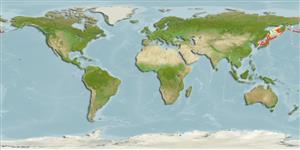
North Pacific: Sea of Okhotsk, Kuril Islands, and the Sea of Japan.
Dimensione / Peso / Età
Maturità: Lm ? range ? - ? cm
Max length : 102 cm TL maschio/sesso non determinato; (Ref. 89865)
Breve descrizione
Chiavi di identificazione | Morfologia | Morfometria
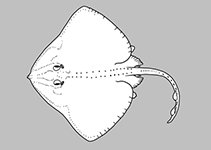
This species is distinguished by the following characters: no blotches on the dorsal disc surface or a pair of white or dark blotches; dark blotch and band usually absent on the ventral disc surface; predorsal caudal vertebrae 80-87 (Ref. 123274)..
Geographical variations are present in the populations of the seas of Japan and Okhotsk: number of total tail thorns, ranging from 21-33 (average and standard deviation: 27.3±2.9) (southern Sea of Japan) vs.19-29 (26.0 ± 2.3) (northern Sea of Japan), vs. 22-27 (24.3 ± 1.5) (Sea of Okhotsk) (P < 0.05) and the frequency distribution of tail thorn numbers was bimodal in the Sea of Japan [modes: 25 and 28,29 (southern); 25,26 and 28 (northern)], but unimodal in the Sea of Okhotsk (mode: 25) (Ref. 123274).
Cross section: flattened.
Oviparous. Distinct pairing with embrace. Young may tend to follow large objects, such as their mother (Ref. 205). Eggs are oblong capsules with stiff pointed horns at the corners deposited in sandy or muddy flats (Ref. 205). Egg capsules are 12.4-15.0 cm long and 8.7-9.0 cm wide (Ref. 41249, 41253). Depth range given by H. Ishihara (pers.comm. 07/07). Reported to feed primarily on amphipods, decapods, fishes, euphausids, and squid on Yamato Bank in the Sea of Japan. Maximum length reported 116 cm TL (Ref, 89865).
Ciclo vitale e comportamento di accoppiamento
Maturità | Riproduzione | Deposizione | Uova | Fecondità | Larve
Oviparous, paired eggs are laid. Embryos feed solely on yolk (Ref. 50449). Distinct pairing with embrace. Young may tend to follow large objects, such as their mother (Ref. 205). Eggs have horn-like projections on the shell (Ref. 205).
Misawa, R., A.M. Orlov, S.Y. Orlova, I.I. Gordeev, H. Ishihara, T. Hamatsu, Y. Ueda, K. Fujiwara, H. Endo and Y. Kai, 2020. Bathyraja (Arctoraja) sexoculata sp. nov., a new softnose skate (Rajiformes: Arhynchobatidae) from Simushir Island, Kuril Islands (western North Pacific), with special reference to geographic variations in Bathyraja (Arctoraja) smirnovi. Zootaxa 4861(4):515-543. (Ref. 123274)
Stato della Lista Rossa IUCN (Ref. 130435: Version 2025-2 (Global))
Minaccia per l'uomo
Harmless
Usi umani
Strumenti
Rapporti speciali
Scarica XML
Fonti Internet
Stime basate su modelli
Temperatura preferita (Fonte Biblio.
123201): 0.6 - 3.8, mean 1.6 °C (based on 122 cells).
Indice di diversità filogenetica (Fonte Biblio.
82804): PD
50 = 0.5000 [Uniqueness, from 0.5 = low to 2.0 = high].
Bayesian length-weight: a=0.00562 (0.00296 - 0.01067), b=3.13 (2.97 - 3.29), in cm total length, based on LWR estimates for this Genus-body shape (Ref.
93245).
Livello trofico (Fonte Biblio.
69278): 4.0 ±0.7 se; based on size and trophs of closest relatives
Resilienza (Fonte Biblio.
120179): Basso, tempo minimo di raddoppiamento della popolazione 4.5 - 14 anni (Fec assumed to be <100).
Vulnerabilità della pesca (Ref.
59153): High vulnerability (61 of 100).
🛈