>
Pleuronectiformes (Flatfishes) >
Soleidae (Soles)
Etymology: Aseraggodes: Greek, aggos, -eos, -ous = vessel, uterus, carapace of a crab + Greek, aseros, -a, -on = to remove the appetite (Ref. 45335).
More on author: Peters.
Umwelt: Milieu / Klimazone / Tiefenbereich / Verbreitungsgebiet
Ökologie
seewasser riff-verbunden; tiefenbereich 1 - 73 m (Ref. 1602). Tropical; 16°N - 18°S
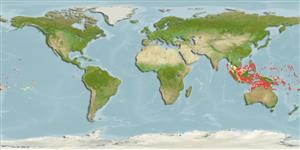
Pacific Ocean: Christmas Island in the eastern Indian Ocean to the Society Islands.
Größe / Gewicht / Alter
Geschlechtsreife: Lm ? range ? - ? cm
Max length : 6.0 cm TL Männchen/unbestimmt; (Ref. 30874)
Kurzbeschreibung
Bestimmungsschlüssel | Morphologie | Morphometrie
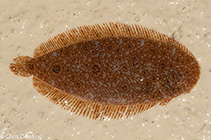
Rückenflossenstacheln (insgesamt) : 0; Rückenflossenweichstrahlen (insgesamt) : 74 - 75; Afterflossenweichstrahlen: 53 - 54; Wirbelzahl: 38. Diagnosis: Dorsal rays 74-75. unbranched; anal rays 53-54. unbranched; caudal rays 18 (uppermost and lowermost 2 rays simple. Middle 12 double-branched); pelvic rays 5, unbranched. Lateral-line scales on ocular side 78-79. including 9 anterior to a vertical at upper end of gill opening. Scales of ocular side of body with 12-16 cteni; scales anteriorly on head progressively shorter. With fewer cteni, modified to small flattened papillae, each with a small flat brown cirrus in zone anteriorly on snout; no broad lappet-like cirri at front of snout or on ventral edge of head, instead cylindrical cirri of variable size, the longest less than pupil diameter; well-spaced slender cirri on opercular edge of gill opening on both sides. Vertebrae 38; dorsal pterygiophores anterior to fourth neural spine 11-13. Body depth 2.3-2.35 in SL; head length (HL) 4.35-4.5 in SL. Snout slightly overhanging lower lip when mouth closed. Lateral line directed anteriorly toward dorsal edge of upper eye. Eye diameter 6.4-6.8 in HL; upper eye overlapping anterior one-half to three-fourths of lower eye; least vertical interorbital space 8.3-8.6 in HL. Upper end of gill opening at level of ventral edge of lower eye. Caudal peduncle absent; depth at base of caudal fin 1.5-1.65 in HL. Longest dorsal ray 1.45 in HL; caudal fin rounded. 5.1-5.8 in SL; ocular-side pelvic fin on ventral edge of body, its base slightly anterior to that of fin of blind side; third pelvic ray longest, 2.0--2.8 in HL, the tip reaching base of second anal ray; lengthwise membranous ridge on dorsal rays of both sides, progressively reduced posteriorly. Small scales on about basal half of membranous ridge of anterior dorsal rays of ocular side; edge of membranous ridge of about first 15 blind-side dorsal rays with prominent cirri. Color of ocular side in alcohol light brown, the scale edges darker than centers, with faint irregular dark-edged pale markings over head and body, and very irregular dark brown blotches. Most much larger than eye, the two largest on lateral line to either side of middle of body; fins with dark dots (Ref. 57560).
Body shape (shape guide): short and / or deep; Cross section: compressed.
Inhabits protected sandy bottoms of lagoon and seaward reefs (Ref. 1602). Feeds on small fishes and crustaceans (Ref. 89972).
Lebenszyklus und Paarungsverhalten
Geschlechtsreife | Fortpflanzung | Ablaichen | Eier | Fruchtbarkeit | Larven
Myers, R.F., 1991. Micronesian reef fishes. Second Ed. Coral Graphics, Barrigada, Guam. 298 p. (Ref. 1602)
IUCN Rote Liste Status (Ref. 130435: Version 2025-2 (Global))
Bedrohung für Menschen
Harmless
Nutzung durch Menschen
Tools
Zusatzinformationen
Download XML
Internet Quellen
Schätzungen auf der Grundlage von Modellen
Bevorzugte Temperatur (Ref.
123201): 26.5 - 29, mean 28 °C (based on 506 cells).
Phylogenetischer Diversitätsindex (Ref.
82804): PD
50 = 0.5000 [Uniqueness, from 0.5 = low to 2.0 = high].
Bayesian length-weight: a=0.00955 (0.00454 - 0.02011), b=3.07 (2.90 - 3.24), in cm total length, based on LWR estimates for this (Sub)family-body shape (Ref.
93245).
Trophische Ebene (Ref.
69278): 3.3 ±0.5 se; based on size and trophs of closest relatives
Widerstandsfähigkeit (Ref.
120179): hoch, Verdopplung der Population dauert weniger als 15 Monate. (Preliminary K or Fecundity.).
Anfälligkeit der Fischerei (Ref.
59153): Low vulnerability (10 of 100).
🛈
Nährstoffe (Ref.
124155): Calcium = 211 [70, 583] mg/100g; Iron = 0.98 [0.36, 2.04] mg/100g; Protein = 18.1 [16.1, 20.2] %; Omega3 = 0.0901 [, ] g/100g; Selenium = 30.8 [13.5, 70.5] μg/100g; VitaminA = 87.5 [21.4, 372.2] μg/100g; Zinc = 1.89 [1.10, 2.97] mg/100g (wet weight);