Entorno: milieu / zona climática / rango de profundidad / gama de distribución
Ecología
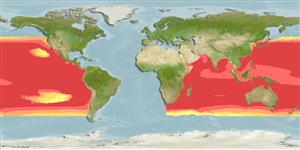
marino pelagic-oceanic; oceanodromo (Ref. 71039); rango de profundidad 0 - 200 m (Ref. 43). Subtropical; 20°C - 25°C (Ref. 54918); 46°N - 49°S, 19°E - 69°W (Ref. 54918)
Indo-Pacific: tropical, subtropical and temperate waters. Highly migratory species.
The distribution in the Pacific Ocean is unique among billfishes and tunas in that it forms a horseshoe-shaped pattern from the northwest Pacific through the eastern Pacific to the southwest Pacific (Ref. 30443). In the Indian Ocean, fish are more densely distributed in equatorial regions with higher concentrations off eastern Africa, in the western Arabian Sea, the Bay of Bengal and off northwestern Australia (Ref. 30444).
Longitud en la primera madurez / Tamaño / Peso / Edad
Madurez: Lm 210.0, range 190 - ? cm
Max length : 420 cm TL macho / no sexado; (Ref. 30874); common length : 290 cm TL macho / no sexado; (Ref. 9308); peso máximo publicado: 440.0 kg (Ref. 30874); edad máxima reportada: 9 años (Ref. 31614)
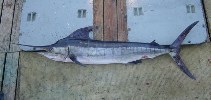
Espinas dorsales (total) : 0; Radios blandos dorsales (total) : 42 - 48; Espinas anales: 0; Radios blandos anales: 18 - 24. Body elongated and compressed; upper jaw produced into a robust and medium sized beak; two dorsal fins, the height of the first greater than the greatest depth, short anteriorly, taller in the middle, then becoming shorter posteriorly; pectoral fins falcate and flexible, with 18 to 22 rays; body densely covered by small, embedded scales with 1 or 2 bluntish points; back dark blue; belly silvery; membrane of first dorsal fin blue black without dark spots; flanks with about 20 bluish stripes (Ref. 55763). Blue-black above and silvery white below, with about 15 rows of cobalt-colored stripes; 1st dorsal fin dark blue; other fins dark brown, sometimes with a tinge of dark blue; anal fin bases with a tinge of silvery white.
Body shape (shape guide): elongated.
Epipelagic and oceanic species, usually found above the thermocline. Generally inhabit cooler water than either black (Makaira indica) or blue marlin (M. mazara) (Ref. 43). Most dominant and widely distributed of all billfishes. Their abundance increases with distance from the continental shelf (Ref. 6390). Usually seen close to shore only where deep drop-offs occur (Ref. 6390). Mostly solitary, but form small schools by size during the spawning season (Ref. 9987). They are usually dispersed at considerably wide distances. Feed on fishes, crustaceans and squids. Also caught with the harpoon. The flesh is the best among billfishes for sashimi and sushi. Marketed mostly frozen, sometimes fresh (Ref. 43); also smoked and frozen (Ref. 9987). Also Ref. 9137, 9574.
Females are indeterminate batch spawners with asynchronous oocyte development (Ref. 92477). Larvae are most abundant in the respective local early summers. The seasonal occurrence of mature females coincides with that of the larvae. The lower temperature limit in the distribution of larvae is approximately 24°C, both in the Indian and Pacific Oceans.
Spawning sites are between 10°S and 30°S in Southwest Pacific and 10°S and 20°S in northeastern Indian Ocean (Ref. 6390).
Nakamura, I., 1985. FAO species catalogue. Vol. 5. Billfishes of the world. An annotated and illustrated catalogue of marlins, sailfishes, spearfishes and swordfishes known to date. FAO Fish. Synop. 125(5):65p. Rome: FAO. (Ref. 43)
Situación en la Lista Roja de la UICN (Ref. 130435: Version 2025-2 (Global))
Amenaza para el ser humano
Harmless
Usos humanos
Pesquerías: comercial; pesca deportiva: si
Herramientas
Informes especiales
Descargar XML
Fuentes de Internet
Estimaciones basadas en modelos
Temperatura preferida (Referencia
123201): 14.6 - 28.3, mean 25.9 °C (based on 1534 cells).
Índice de diversidad filogenética (Referencia
82804): PD
50 = 0.7505 [Uniqueness, from 0.5 = low to 2.0 = high].
Bayesian length-weight: a=0.00550 (0.00302 - 0.01002), b=3.15 (2.98 - 3.32), in cm total length, based on LWR estimates for this species & (Sub)family-body (Ref.
93245).
Nivel trófico (Referencia
69278): 4.5 ±0.73 se; based on food items.
Generation time: 2.5 (1.5 - 5.0) years. Estimated as median ln(3)/K based on 13
growth studies.
Resiliencia (Referencia
120179): Medio, población duplicada en un tiempo mínimo de 1.4-4.4 años (K=0.2-0.8; tm=2-3; tmax=9; Fec=90-281 million (annual reproductive output)).
Prior r = 0.37, 95% CL = 0.25 - 0.56, Based on 6 full stock assessments.
Vulnerabilidad pesquera (Ref.
59153): Moderate vulnerability (44 of 100).
🛈
Vulnerabilidad climática (Ref.
125649): Moderate to high vulnerability (48 of 100).
🛈
Nutrientes (Ref.
124155): Calcium = 29.3 [12.2, 54.6] mg/100g; Iron = 0.97 [0.53, 1.79] mg/100g; Protein = 19.9 [18.6, 21.0] %; Omega3 = 0.217 [0.110, 0.427] g/100g; Selenium = 50.6 [25.2, 110.9] μg/100g; VitaminA = 3.89 [1.10, 13.77] μg/100g; Zinc = 0.31 [0.20, 0.48] mg/100g (wet weight);