>
Cichliformes (Cichlids, convict blennies) >
Cichlidae (Cichlids) > Pseudocrenilabrinae
Etymology: Tyrannochromis: Greek, tyranos = despotic + Greek, chromis = a fish, perhaps a perch (Ref. 45335).
More on author: Regan.
Taxonomic Remarks
Quote Snoeks and Hanssens, 2004 (Ref. 55954): "We tentatively accept the synonymy of T. polyodon (Trewavas, 1935) and T. maculiceps (Ahl, 1927) with this species (T. macrostoma (Regan, 1922)) as suggested by Konings (1996). A definite conclusion cannot be given, as we have not examined the types of these nominal species."
Umwelt: Milieu / Klimazone / Tiefenbereich / Verbreitungsgebiet
Ökologie
; süßwasser demersal; pH range: 7.4 - 8.4; dH range: 7 - 30. Tropical; 23°C - 27°C (Ref. 12468); 9°S - 15°S
Africa: Endemic to Lake Malawi.
Größe / Gewicht / Alter
Geschlechtsreife: Lm ? range ? - ? cm
Max length : 30.0 cm TL Männchen/unbestimmt; (Ref. 5715)
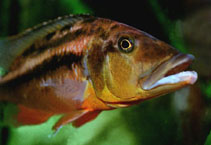
Found over rocky areas in shallow water (Ref. 267). Piscivore, feeds by moving around rocks and into cracks in search of its unwary prey, the Mbunas, which are quickly snapped up with the large mouth (Ref. 5595).
Lebenszyklus und Paarungsverhalten
Geschlechtsreife | Fortpflanzung | Ablaichen | Eier | Fruchtbarkeit | Larven
Guards offspring for more than 3 weeks. Young become independent when they reach 3.8-4.0 cm SL and are able to move around as solitary hunters in the rocky habitats.
Maréchal, C., 1991. Tyrannochromis. p. 534-535. In J. Daget, J.-P. Gosse, G.G. Teugels and D.F.E. Thys van den Audenaerde (eds.) Check-list of the freshwater fishes of Africa (CLOFFA). ISNB, Brussels; MRAC, Tervuren; and ORSTOM, Paris. Vol. 4. (Ref. 5715)
IUCN Rote Liste Status (Ref. 130435: Version 2025-2 (Global))
Bedrohung für Menschen
Harmless
Nutzung durch Menschen
Fischereien: kommerziell; Aquarium: Kommerziell
Tools
Zusatzinformationen
Download XML
Internet Quellen
Schätzungen auf der Grundlage von Modellen
Phylogenetischer Diversitätsindex (Ref.
82804): PD
50 = 0.5625 [Uniqueness, from 0.5 = low to 2.0 = high].
Bayesian length-weight: a=0.00389 (0.00180 - 0.00842), b=3.12 (2.94 - 3.30), in cm total length, based on all LWR estimates for this body shape (Ref.
93245).
Trophische Ebene (Ref.
69278): 4.2 ±0.73 se; based on food items.
Widerstandsfähigkeit (Ref.
120179): mittel, Verdopplung der Population dauert 1,4 - 4,4 Jahre. (Preliminary K or Fecundity.).
Anfälligkeit der Fischerei (Ref.
59153): Low vulnerability (20 of 100).
🛈
Nährstoffe (Ref.
124155): Calcium = 166 [84, 328] mg/100g; Iron = 1.65 [0.90, 3.45] mg/100g; Protein = 18.7 [17.1, 20.2] %; Omega3 = 0.341 [0.130, 0.965] g/100g; Selenium = 66.2 [27.7, 168.6] μg/100g; VitaminA = 57.6 [14.3, 189.2] μg/100g; Zinc = 1.42 [0.91, 2.17] mg/100g (wet weight);