>
Cichliformes (Cichlids, convict blennies) >
Cichlidae (Cichlids) > Pseudocrenilabrinae
Etymology: Protomelas: Greek, protos = the first + Greek, melas, melanos = black (Ref. 45335).
More on author: Trewavas.
Umwelt: Milieu / Klimazone / Tiefenbereich / Verbreitungsgebiet
Ökologie
; süßwasser benthopelagisch. Tropical; 24°C - 26°C (Ref. 2059); 9°S - 15°S
Africa: Endemic to Lake Malawi where it is widely distributed.
Größe / Gewicht / Alter
Geschlechtsreife: Lm ? range ? - ? cm
Max length : 11.3 cm TL Männchen/unbestimmt; (Ref. 4996)
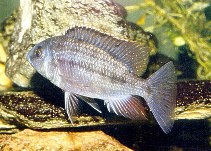
Rückenflossenstacheln (insgesamt) : 16 - 17; Rückenflossenweichstrahlen (insgesamt) : 10 - 11; Afterflossenstacheln: 3; Afterflossenweichstrahlen: 9 - 10; Wirbelzahl: 31. Resembles P. fenestratus in form and in ecology, but differs from it in having a larger eye and consequently narrower preorbital, in the more numerous teeth in the upper jaw and on the lower pharyngeal, the higher number of gill rakers, the anterior of which, although short, are acute and well defined and in the higher modal number of dorsal spines. Differs from P. virgatus in the absence of enlarged pharyngeal teeth.
Body shape (shape guide): fusiform / normal; Cross section: compressed.
Inhabits shallow, rocky sediment-free habitat. Feeds on 'aufwuchs' attached to rocks, but also takes small invertebrates, including zooplankton when this is abundant (Ref. 267).
Lebenszyklus und Paarungsverhalten
Geschlechtsreife | Fortpflanzung | Ablaichen | Eier | Fruchtbarkeit | Larven
Parents practice co-operative care of young by grouping together and setting up protective stations close to one another; releasing their young and embarking upon parental care. Every protective mantle is very close to the next in such a way that young can move from one parent to the next.
Maréchal, C., 1991. Protomelas. p. 387-393. In J. Daget, J.-P. Gosse, G.G. Teugels and D.F.E. Thys van den Audenaerde (eds.) Check-list of the freshwater fishes of Africa (CLOFFA). ISNB, Brussels; MRAC, Tervuren; and ORSTOM, Paris. Vol. 4. (Ref. 4996)
IUCN Rote Liste Status (Ref. 130435: Version 2025-2 (Global))
Bedrohung für Menschen
Harmless
Nutzung durch Menschen
Fischereien: kommerziell; Aquarium: Kommerziell
Tools
Zusatzinformationen
Download XML
Internet Quellen
Schätzungen auf der Grundlage von Modellen
Phylogenetischer Diversitätsindex (Ref.
82804): PD
50 = 0.5000 [Uniqueness, from 0.5 = low to 2.0 = high].
Bayesian length-weight: a=0.01445 (0.00671 - 0.03113), b=2.99 (2.82 - 3.16), in cm total length, based on LWR estimates for this (Sub)family-body shape (Ref.
93245).
Trophische Ebene (Ref.
69278): 3.2 ±0.37 se; based on food items.
Widerstandsfähigkeit (Ref.
120179): hoch, Verdopplung der Population dauert weniger als 15 Monate. (Preliminary K or Fecundity.).
Anfälligkeit der Fischerei (Ref.
59153): Low vulnerability (10 of 100).
🛈