>
Siluriformes (Catfishes) >
Clariidae (Airbreathing catfishes)
Etymology: Clarias: Greek, chlaros = lively, in reference to the ability of the fish to live for a long time out of water.
More on author: Gill.
Ambiente: milieu / zona climatica / distribuzione batimetrica / gamma di distribuzione
Ecologia
; acqua dolce demersale. Tropical; 8°N - 3°N
Africa: C. laeviceps laeviceps: river St. John in Liberia to the Volta in Ghana; also found in the upper Niger in Guinea (Ref. 57129). Possibly also in the St. Paul River (Ref. 248, 13331). C. laeviceps dialonensis: rivers coming out of the Fouta Djalon (Konkouré, Kolenté), the upper Senegal River in Guinea and coastal basins in Sierra Leone; endemic to that region (Ref. 57129).
Dimensione / Peso / Età
Maturità: Lm ? range ? - ? cm
Max length : 31.7 cm TL maschio/sesso non determinato; (Ref. 57129)
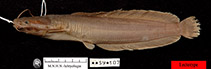
Spine dorsali (totale) : 0; Raggi dorsali molli (totale) : 74 - 93; Spine anali: 0; Raggi anali molli: 60 - 75; Vertebre: 65 - 69. Diagnosis: body very elongate, its depth 9.1-13.6% SL (m = 12.0)(Ref. 57129). Head short and broad (Ref. 248, 571429), oval-shaped dorsally (Ref. 248), its length 17.8-22.7% SL (m=21.1), its width 13.4-17.0% SL (m=16.0)(Ref. 57129). Snout broadly rounded; eyes more laterally placed (Ref. 248). Interorbital distance large, 44.7-54.8% HL (m = 49.5)(Ref. 57129). Tooth plates broad (Ref. 248, 57129), width of premaxillary plate 31.8-41.3% HL, width of vomerine plate 25.6-35.0% HL (Ref. 57129). Frontal fontanelle intermediate between "knife-shaped" and "sole-shaped"; occipital fontanelle rather long and oval shaped; supraorbital and "dermosphenotic" bones become joined in specimens between 80 and 100 mm TL (Ref. 248). Dorsal and anal fins very long (63.2-72.0% and 49.7-57.6% SL respectively) (Ref. 57129). Gill rakers small, slender and distantly set; suprabranchial organ partially fills chamber; pectoral spine rather thin and slightly curved (Ref. 248).
Coloration: no information on colour in life (Ref. 57129). Preserved specimens: 2 types of colouration: one uniform, with back and sides blackish-brown and belly beige; and a marbled pattern with light spots against a dark background on back and sides, and pale brown on belly (Ref. 57129). Caudal fin with dark vertical bar occupying 2/3 of its base, dividing it in a dark anterior and a light posterior part (Ref. 57129).
Body shape (shape guide): elongated; Cross section: circular.
Facultative air-breathing (Ref. 126274); Nothing is known regarding the biology of this species (Ref. 78218). Max. reported size of C. laeviceps laeviceps and C. laeviceps dialonensis is 317mm TL and 257mm TL respectively (Ref. 57129)
Ciclo vitale e comportamento di accoppiamento
Maturità | Riproduzione | Deposizione | Uova | Fecondità | Larve
Teugels, G.G., 1986. A systematic revision of the African species of the genus Clarias (Pisces; Clariidae). Ann. Mus. R. Afr. Centr., Sci. Zool., 247:199 p. (Ref. 248)
Stato della Lista Rossa IUCN (Ref. 130435: Version 2025-2 (Global))
Minaccia per l'uomo
Harmless
Usi umani
Strumenti
Rapporti speciali
Scarica XML
Fonti Internet
Stime basate su modelli
Indice di diversità filogenetica (Fonte Biblio.
82804): PD
50 = 0.5000 [Uniqueness, from 0.5 = low to 2.0 = high].
Bayesian length-weight: a=0.00776 (0.00372 - 0.01620), b=2.96 (2.79 - 3.13), in cm total length, based on LWR estimates for this Genus-body shape (Ref.
93245).
Livello trofico (Fonte Biblio.
69278): 3.4 ±0.5 se; based on size and trophs of closest relatives
Resilienza (Fonte Biblio.
120179): Alto, tempo minimo di raddoppiamento della popolazione meno di 15 mesi (Preliminary K or Fecundity.).
Vulnerabilità della pesca (Ref.
59153): Low vulnerability (22 of 100).
🛈