>
Myctophiformes (Lanternfishes) >
Myctophidae (Lanternfishes) > Myctophinae
Etymology: Benthosema: Greek, benthos = depth of the sea + Greek, sema, sematos = signal, flag (Ref. 45335).
Miljö: miljö / Klimatzon / djupintervall / distributionsområde
Ekologi
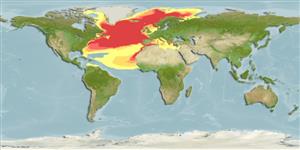
marina pelagic-oceanic; ej vandrande; djupintervall 0 - 1407 m (Ref. 58426), usually 300 - 400 m (Ref. 82363). Deep-water; 81°N - 7°N, 81°W - 61°E
Eastern Atlantic: Norway and Greenland south to Morocco, and from Mauritania to Guinea (Mauritanian Upwelling Region). Seasonally present from Morocco to Mauritania along the edge of the continental shelf. Also known from the Mediterranean Sea. Western Atlantic: Baffin Bay to northern edge of Gulf Stream. Northwest Atlantic: Canada (Ref. 5951).
Längd vid första mognad / Storlek / Vikt / Ålder
Könsmognad: Lm 3.6, range 2 - 5.5 cm
Max length : 10.3 cm SL hane/ej könsbestämd; (Ref. 4479); rapporterad maxålder: 8 år (Ref. 35388)
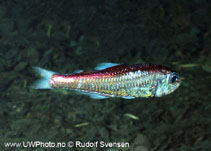
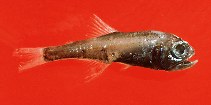
Taggstrålar i ryggfenan (totalt) : 0; Mjukstrålar i ryggfenan (totalt) : 13 - 14; Mjukstrålar i analfenan: 17 - 19. Males with single black-bordered supracaudal gland; females with two infra-caudal luminous patches; occasional specimens with both. Luminous organs in the anal area, 5-6 anteriorly and 5-7 posteriorly, 11-13 total.
Body shape (shape guide): fusiform / normal.
High-oceanic, mesopelagic at depths between 375-800 m during daytime and 12-200 m during night. Depth range from 0-850 m (Ref. 4479) and from 541-1085 m in the eastern Ionian Sea (Ref. 56504). Photophores present. Feeds mainly on calanoid copepods, also euphausiids and copepodites. Feeding occurs at night in Norwegian fjords (Ref. 9209) and in northwest Africa (Ref. 9194). Mature from about 3 cm onward. Spawning peaks in the Mediterranean in late spring with east-to-west progression. Female produces 160-2,000 eggs depending on her size (Ref. 35388).
Spawns both north and south of the Polar Fronts in the eastern North Atlantic. Reported to perish after spawning (Ref. 9707).
Bauchot, M.-L., 1987. Poissons osseux. p. 891-1421. In W. Fischer, M.L. Bauchot and M. Schneider (eds.) Fiches FAO d'identification pour les besoins de la pêche. (rev. 1). Méditerranée et mer Noire. Zone de pêche 37. Vol. II. Commission des Communautés Européennes and FAO, Rome. (Ref. 3397)
Status på IUCN:s rödlista (Ref. 130435: Version 2025-2 (Global))
Hot mot människor
Harmless
Mänskliga användningsområden
Fiskeri: av potentiellt intresse
Verktyg
Särskilda rapporter
Ladda ner XML
Internet-källor
Uppskattningar baserade på modeller
Önskad temperatur (Ref.
123201): 1.6 - 12.8, mean 5.1 °C (based on 258 cells).
Index för fylogenetisk mångfald (Ref.
82804): PD
50 = 0.5312 [Uniqueness, from 0.5 = low to 2.0 = high].
Bayesian length-weight: a=0.00871 (0.00703 - 0.01079), b=3.09 (3.03 - 3.15), in cm total length, based on LWR estimates for this species (Ref.
93245).
Trofisk nivå (Ref.
69278): 3.1 ±0.29 se; based on food items.
Resiliens (Ref.
120179): Mellan, lägsta populationsfördubblingstid 1,4-4,4 år (K=0.20-0.45; tm=1-3; tmax=8; Fec=162).
Sårbarhet i fisket (Ref.
59153): Low to moderate vulnerability (27 of 100).
🛈
Näringsämnen (Ref.
124155): Calcium = 123 [33, 471] mg/100g; Iron = 1.07 [0.34, 3.69] mg/100g; Protein = 17.1 [14.5, 19.6] %; Omega3 = 1.11 [0.47, 2.67] g/100g; Selenium = 21.5 [5.3, 95.2] μg/100g; VitaminA = 58.7 [7.6, 434.5] μg/100g; Zinc = 0.697 [0.293, 1.744] mg/100g (wet weight);