>
Siluriformes (Catfishes) >
Clariidae (Airbreathing catfishes)
Etymology: Clarias: Greek, chlaros = lively, in reference to the ability of the fish to live for a long time out of water.
Eponymy: Carolus Franciscus Sala (1839–1881) was a Dutch soldier and collector. [...] (Ref. 128868), visit book page.
Ambiente: milieu / zona climatica / distribuzione batimetrica / gamma di distribuzione
Ecologia
; acqua dolce demersale. Tropical; 22°C - 28°C (Ref. 13614); 12°N - 4°N
Africa: from the Géba (Guinea-Bissau) to the Cavally (Côte d'Ivoire) (Ref. 57129). Also reported from the Casamance (Senegal)(Ref. 57129).
Dimensione / Peso / Età
Maturità: Lm ? range ? - ? cm
Max length : 50.8 cm TL maschio/sesso non determinato; (Ref. 57129)
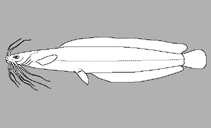
Spine dorsali (totale) : 0; Raggi dorsali molli (totale) : 79 - 93; Spine anali: 0; Raggi anali molli: 67 - 79; Vertebre: 63 - 68. Diagnosis: typical extremely elongate, eel-shaped body (maximum body depth 8.7-13.9% of standard length); head length 20.2% SL (Ref. 57129). Head rather rectangular in dorsal outline; snout broadly rounded; eyes more dorsally located; frontal fontanelle intermediate between "knife-shaped" and "sole-shaped"; occipital fontanelle broadly oval-shaped; "dermosphenotic" and supraorbital bones are joined; tooth plates relatively small; premaxillary longer than vomerine (Ref. 248). Distance between occipital process and dorsal-fin base relatively large (8.3-12.4% of standard length); dorsal and anal fins (67.7-75.0% and 50.6-58.9%, respectively, of standard length) very long and sometimes partially confluent with caudal fin (Ref. 57129). Pectoral spine serrated on both sides (Ref. 248, 57129). Gill rakers long and distantly set (Ref. 248).
Coloration: fresh specimens dark brown on back; sides marked with irregular blackish spots, belly light brown to beige; a vertical bar may be present on caudal fin (Ref. 57129). Flanks with vertical rows of small white spots (Ref. 248, 57129).
Body shape (shape guide): elongated; Cross section: circular.
Facultative air-breathing (Ref. 126274); Occurs in river systems which arise in mountainous areas and are entirely within the rain forest (Ref. 248). Very little is known about the biology, but on basis of its distribution the species appears to be restricted to the rain forest (Ref. 78218).
Ciclo vitale e comportamento di accoppiamento
Maturità | Riproduzione | Deposizione | Uova | Fecondità | Larve
Teugels, G.G., 1986. A systematic revision of the African species of the genus Clarias (Pisces; Clariidae). Ann. Mus. R. Afr. Centr., Sci. Zool., 247:199 p. (Ref. 248)
Stato della Lista Rossa IUCN (Ref. 130435: Version 2025-2 (Global))
Minaccia per l'uomo
Harmless
Usi umani
Strumenti
Rapporti speciali
Scarica XML
Fonti Internet
Stime basate su modelli
Indice di diversità filogenetica (Fonte Biblio.
82804): PD
50 = 0.5000 [Uniqueness, from 0.5 = low to 2.0 = high].
Bayesian length-weight: a=0.00575 (0.00363 - 0.00912), b=2.96 (2.83 - 3.09), in cm total length, based on LWR estimates for this species & Genus-body shape (Ref.
93245).
Livello trofico (Fonte Biblio.
69278): 3.5 ±0.5 se; based on size and trophs of closest relatives
Resilienza (Fonte Biblio.
120179): Medio, tempo minimo di raddoppiamento della popolazione 1.4 - 4.4 anni (Preliminary K or Fecundity.).
Vulnerabilità della pesca (Ref.
59153): Moderate vulnerability (40 of 100).
🛈