>
Siluriformes (Catfishes) >
Clariidae (Airbreathing catfishes)
Etymology: Clarias: Greek, chlaros = lively, in reference to the ability of the fish to live for a long time out of water.
Environnement : milieu / zone climatique / profondeur / gamme de distribution
Écologie
; eau douce démersal; potamodrome (Ref. 51243). Tropical; 8°N - 3°N
Africa: Ofin river and Volta system (Ghana), coastal rivers in Togo, Ouémé river (Benin), and in the Ogun, Oshun, lower Niger, Niger delta and Cross (Nigeria) (Ref. 57129).
Longueur à la première maturité / Taille / Poids / Âge
Maturité: Lm ?, range 12 - ? cm
Max length : 29.0 cm TL mâle / non sexé; (Ref. 31579); poids max. publié: 178.00 g (Ref. 31579)
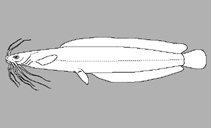
Épines dorsales (Total) : 0; Rayons mous dorsaux (Total) : 65 - 82; Épines anales: 0; Rayons mous anaux: 52 - 63; Vertèbres: 53 - 54. Diagnosis: head oval-shaped in dorsal outline (Ref. 248), fairly broad (width 15.9-21.1% SL) and rather long (24.1-27.6% SL)(Ref. 57129, 81644). Snout rounded (Ref. 248). Tooth plates small (Ref. 248). Width of premaxillary tooth plate 22.3-27.5% HL (m=24.9), of vomerine plate 19.9-24.5% HL; interorbital space relatively narrow (40.6-46.1% HL, averaging 42.8% HL) (Ref. 57129, 81644). Barbels relatively short, but longer than head (Ref. 57129). Frontal fontanelle usually short and wide/squat ('sole-shaped')(Ref. 248, 57129). Occipital fontanelle small and oval-shaped; supraorbital and 'dermosphenotic' bones become sutured (Ref. 248). Pectoral spine robust and slightly curved (Ref. 248), with serrations on anterior and posterior margin (Ref. 57129, 81644). Gill rakers long and distantly set; suprabranchial organ well developed; openings of the secondary canals of the lateral line appear as irregular white spots on the body (Ref. 248). 15-24 gill rakers on first gill arch; 52-63 anal fin rays (Ref. 81644).
Coloration: characteristic for its very light colouration; back and sides yellowish brown, belly clear/light grey (Ref. 57129, 81644).
Body shape (shape guide): elongated; Cross section: oval.
Facultative air-breathing (Ref. 126274); Found more abundant in forest floodplain ponds, grassland floodplain ponds and marshes than in rivers (Ref. 31579). Maximum reported size 235 mm TL for West Africa (Ref. 57129) and Lower Guinea (Ref. 81644).
Teugels, G.G., 1986. A systematic revision of the African species of the genus Clarias (Pisces; Clariidae). Ann. Mus. R. Afr. Centr., Sci. Zool., 247:199 p. (Ref. 248)
Statut dans la liste rouge de l'IUCN (Ref. 130435: Version 2025-2 (Global))
Menace pour l'homme
Harmless
Utilisations par l'homme
Outils
Articles particuliers
Télécharger en XML
Sources Internet
Estimations basées sur des modèles
Indice de diversité phylogénétique (Réf.
82804): PD
50 = 0.5000 [Uniqueness, from 0.5 = low to 2.0 = high].
Bayesian length-weight: a=0.00759 (0.00479 - 0.01202), b=2.98 (2.85 - 3.11), in cm total length, based on LWR estimates for this species & Genus-body shape (Ref.
93245).
Niveau trophique (Réf.
69278): 3.7 ±0.3 se; based on diet studies.
Résilience (Réf.
120179): Haut, temps minimum de doublement de population inférieur à 15 mois (tm=1; K=0.89; mean Fec=9,596).
Vulnérabilité de la pêche (Ref.
59153): Low vulnerability (19 of 100).
🛈