>
Siluriformes (Catfishes) >
Clariidae (Airbreathing catfishes)
Etymology: Clarias: Greek, chlaros = lively, in reference to the ability of the fish to live for a long time out of water.
More on author: Castelnau.
Ambiente: milieu / zona climática / intervalo de profundidade / gama de distribuição
Ecologia
; Água doce; estuarina demersal; potamódromo (Ref. 51243). Tropical; 11°S - 27°S
Africa: Quanza, Cunene, Okavango, Chobe, Lake Ngami, upper Zambezi (above Victoria Falls), Kafue, Lake Malawi, upper Lualaba, Luapula, Lakes Moero and Bangweulu, Pungwe, Buzi, Save, Limpopo, Incomati, lower Pongolo and lower Sabi/Lundi system (Ref. 248). Also reported from the lower Shire (Ref. 7248, 52193)
Tamanho / Peso / Idade
Maturidade: Lm ? range ? - ? cm
Max length : 73.0 cm TL macho/indeterminado; (Ref. 52193); peso máx. Publicado: 4.0 kg (Ref. 52193)
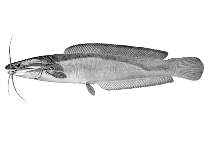
Espinhos dorsais (total) : 0; Raios dorsais moles (total) : 56 - 62; Espinhos anais: 0; Raios anais moles: 50 - 58; Vértebras: 56 - 60. Diagnosis: Characterized by a relatively long vomerine tooth plate (5.9-14.4% of head length) and by a relatively short adipose fin (5.9-12.5% of standard length), the length of which is a specific character of Clarias ngamensis; head oval to rectangular in dorsal outline; frontal fontanelle long and narrow (`knife-shaped'); occipital fontanelle small and oval-shaped; pectoral spine robust and slightly curved; the suprabranchial organ consists of well developed arborescent structures (Ref. 248). It is distinguished from Clarias gariepinus by having a short adipose fin behind the rayed dorsal and an ovoid vomerine toothplate with granular or blunt teeth (Ref. 52193).
Body shape (shape guide): elongated; Cross section: oval.
Facultative air-breathing (Ref. 126274); The species seems to be nowhere especially abundant but is fairly common in some areas such as weed beds, permanent swamps, quieter waters and muddy bottoms (Ref. 248, 5595). Prefers vegetated habitats. Feeding habits overlap considerably with the sharptooth catfish. Important foods are mollusks, terrestrial and aquatic insects, insect larvae, shrimps, grain, crabs and fish (Ref. 4967, 78218). Feeds on snails (Ref. 5595). Hard-shelled foods such as mussels are crushed before they are swallowed. Breeds during the summer rainy season. May live for 5-6 years (Ref. 7248). Also caught with drawnets (Ref. 4967).
Ciclo de vida e comportamento de acasalamento
Maturidade | Reprodução | Desova | Ovos | Fecundidade | Larvas
Breeding is reportedly flood dependent and similar to that of C. gariepinus.
Teugels, G.G., 1986. A systematic revision of the African species of the genus Clarias (Pisces; Clariidae). Ann. Mus. R. Afr. Centr., Sci. Zool., 247:199 p. (Ref. 248)
Categoria na Lista Vermelha da IUCN (Ref. 130435: Version 2025-2 (Global))
Ameaça para o homem
Harmless
Utilização humana
Pescarias: espécies comerciais; Aquacultura: espécies comerciais; peixe desportivo: sim; Aquário: Espécies comerciais
Ferramentas
Relatórios especiais
Descarregue XML
Fontes da internet
Estimativas baseadas em modelos
Índice de diversidade filogenética (Ref.
82804): PD
50 = 0.5000 [Uniqueness, from 0.5 = low to 2.0 = high].
Bayesian length-weight: a=0.00776 (0.00432 - 0.01396), b=2.98 (2.83 - 3.13), in cm total length, based on LWR estimates for this species & Genus-body shape (Ref.
93245).
Nível Trófico (Ref.
69278): 4.3 ±0.5 se; based on diet studies.
Resiliência (Ref.
120179): Médio, tempo mínimo de duplicação da população 1,4 - 4,4 anos (K=0.22-0.41).
Vulnerabilidade da pesca (Ref.
59153): Moderate vulnerability (36 of 100).
🛈
Nutrientes (Ref.
124155): Calcium = 29.1 [14.5, 133.1] mg/100g; Iron = 1.04 [0.62, 1.87] mg/100g; Protein = 17.2 [16.1, 18.2] %; Omega3 = 0.137 [0.066, 0.309] g/100g; Selenium = 90.7 [37.8, 217.9] μg/100g; VitaminA = 15.2 [5.6, 41.2] μg/100g; Zinc = 0.547 [0.403, 0.741] mg/100g (wet weight);