>
Osteoglossiformes (Bony tongues) >
Mormyridae (Elephantfishes)
Etymology: Gnathonemus: Greek, gnathos = jaw + Greek, nema = filament (Ref. 45335).
Eponymy: Wilhelm Karl Hartwig Peters (1815–1883) was a German zoologist and traveller who made some very important collections in Mozambique. [...] (Ref. 128868), visit book page.
More on author: Günther.
Ambiente: milieu / zona climatica / distribuzione batimetrica / gamma di distribuzione
Ecologia
; acqua dolce demersale; pH range: 6.0 - 8.0; dH range: 5 - 19. Tropical; 22°C - 28°C (Ref. 1672)
Dimensione / Peso / Età
Maturità: Lm ? range ? - ? cm
Max length : 35.0 cm SL maschio/sesso non determinato; (Ref. 2915)
Spine dorsali (totale) : 0; Raggi dorsali molli (totale) : 25 - 31; Spine anali: 0; Raggi anali molli: 32 - 36.
Body shape (shape guide): fusiform / normal; Cross section: compressed.
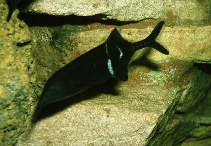
Occurs close to the bottom where it probes for food with the long snout. Territorial and usually aggressive towards members of its own species. This behavior has been shown to involve electric organ discharge (EOD) activity (Ref. 10011). Feeds mostly at night on worms and insects (Ref. 7020), probably aided by electro-sensory inputs (Ref. 10011). Electroreceptors are distributed over the entire head, the dorsal and ventral regions of the body, but absent from the side and the caudal peduncle where the electric organ is located (Ref. 10011). Sex-related EOD characteristics in this species has been demonstrated in the laboratory with freshly imported samples during the breeding season; such EOD dimorphism changed with time in captivity (Ref. 10764; 10766). Lead nitrate in water significantly increased EOD rate and selectively altered the EOD waveform of this species (Ref. 10469). Dubbed a `hearing specialist' having auditory abilities in the range of 100-2500 Hz, with `best frequencies' between 300 and 600 Hz (Ref. 10830). Aquarium keeping: in groups of 5 or more individuals; minimum aquarium size 150 cm; not recommended for home aquariums (Ref. 51539).
Ciclo vitale e comportamento di accoppiamento
Maturità | Riproduzione | Deposizione | Uova | Fecondità | Larve
Gosse, J.-P., 1984. Mormyridae. p. 63-122. In J. Daget, J.-P. Gosse and D.F.E. Thys van den Audenaerde (eds.) Check-list of the freshwater fishes of Africa (CLOFFA). ORSTOM, Paris and MRAC, Tervuren. Vol. 1. (Ref. 3203)
Stato della Lista Rossa IUCN (Ref. 130435: Version 2025-2 (Global))
Minaccia per l'uomo
Harmless
Usi umani
Pesca: pesca di sussistenza; Acquario: Commerciale
Strumenti
Rapporti speciali
Scarica XML
Fonti Internet
Stime basate su modelli
Indice di diversità filogenetica (Fonte Biblio.
82804): PD
50 = 0.5625 [Uniqueness, from 0.5 = low to 2.0 = high].
Bayesian length-weight: a=0.01259 (0.00585 - 0.02711), b=2.87 (2.69 - 3.05), in cm total length, based on LWR estimates for this (Sub)family-body shape (Ref.
93245).
Livello trofico (Fonte Biblio.
69278): 3.1 ±0.34 se; based on food items.
Resilienza (Fonte Biblio.
120179): Medio, tempo minimo di raddoppiamento della popolazione 1.4 - 4.4 anni (Preliminary K or Fecundity.).
Vulnerabilità della pesca (Ref.
59153): Low to moderate vulnerability (33 of 100).
🛈
Nutrienti (Ref.
124155): Calcium = 169 [84, 395] mg/100g; Iron = 1.59 [0.74, 3.23] mg/100g; Protein = 17.7 [15.3, 20.0] %; Omega3 = 0.518 [0.209, 1.314] g/100g; Selenium = 70.2 [26.4, 176.7] μg/100g; VitaminA = 35.8 [12.9, 96.4] μg/100g; Zinc = 1.74 [1.14, 3.40] mg/100g (wet weight);