การจำแนกประเภท / ชื่อ
ชื่อสามัญ | ชื่อพ้อง | Catalog of Fishes(สกุล, ชนิด) | ITIS | CoL | WoRMS | Cloffa
สิ่งแวดล้อม : สิ่งแวดล้อม / เขตภูมิอากาศ / ระดับความลึก / ระยะการกระจายสินค้า
นิเวศวิทยา
เกี่ยวกับทะเล,น้ำเค็ม; น้ำจืด; กร่อย pelagic-neritic; ปลาที่อพยพจากแหล่งน้ำเค็มไปวางไข่ในแหล่งน้ำจืด (Ref. 138126); ระดับความลึก 70 - 180 m. Temperate; 10°C - 20°C (Ref. 2059); 57°N - 35°N, 13°E - 60°E
Eurasia: Caspian, Black, Azov and Adriatic Sea basins.
Extirpated from Adriatic Sea.
ความยาวเมื่อครบกำหนดครั้งแรก / ขนาด / น้ำหนัก / อายุ
วัยเจริญพันธุ์: Lm ?, range 200 - ? cm
Max length : 800 cm TL เพศผู้/กระเทย; (Ref. 59043); common length : 215 cm TL เพศผู้/กระเทย; (Ref. 3397); น้ำหนักสูงสุดที่มีการรายงาน: 3.2 t (Ref. 59043); อายุสูงสุดที่ได้รายงาน: 118 ปี (Ref. 47437)
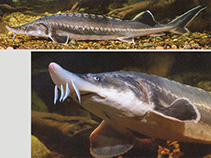
เงี่ยงครีบหลัง (รวม) : 0; ก้านครีบอ่อนที่หาง (รวม) : 62 - 73; เงี่ยงครีบก้น: 0; ก้านครีบอ่อนที่ก้น: 28 - 41. Snout moderate and pointed, turning slightly upward. Lower lip not continuous, interrupted at center. Barbels oval or flat, leaf-like posteriorly, reaching almost to mouth. Five rows of scutes, dorsal 11-14 (first one smallest), lateral 41-52 on each side, ventral 9-11 on each side. Back ash-grey or greenish, flanks lighter, belly white.
Body shape (shape guide): elongated; Cross section: circular.
Pelagic at the sea, following its prey. Undertakes upriver migration to spawn. Juveniles occur in shallow riverine habitats during their first summer. Spawns in the main course of large and deep rivers with strong current and on stone or gravel bottom (Ref. 59043). Feeds mostly on sea fishes (Black Sea whiting, anchovies, flatfishes, gobies, fry of bottom-living fishes), also crustaceans, mollusks, mysids and amphipods. Fisheries are based almost entirely on the value of the caviar, but meat also is sold fresh, smoked and frozen; eaten broiled, boiled, fried and baked (Ref. 9988). Bester, a hybrid of female Huso huso and male sterlet Acipenser ruthenus, has been successfully cultivated for its high quality eggs (Ref. 9988). The largest sturgeon and largest European freshwater fish. In Guinness Book of Records as the most expensive fish (Ref. 6472). Threatened due to overfishing for meat at the sea and for caviar in estuaries. These threats will soon cause global extinction of the natural populations. Survival can only depend on stocking (Ref. 59043).
Enters rivers from March, usually April and May (also in autumn). Survives largely by artificial propagation. About 360,000-7,700,000 eggs per female. Females carry eggs only once every five to seven years (Ref. 9988).
Kottelat, M. and J. Freyhof, 2007. Handbook of European freshwater fishes. Publications Kottelat, Cornol and Freyhof, Berlin. 646 pp. (Ref. 59043)
สถานะบัญชีแดงของ IUCN (Ref. 130435: Version 2025-2 (Global))
ภัยคุกคามต่อมนุษย์
Harmless
การใช้ของมนุษย์
การประมง: การค้า; การเพาะเลี้ยงสัตว์น้ำ: การค้า
เครื่องมือ
รายงานพิเศษ
ดาวน์โหลด XML
แหล่งที่มาจากอินเตอร์เน็ต
การประมาณค่าตามแบบจำลอง
อุณหภูมิที่ต้องการ (อ้างอิง
123201): 7.7 - 15.6, mean 9.1 °C (based on 19 cells).
ดัชนีความหลากหลายทางวิวัฒนาการ (อ้างอิง
82804): PD
50 = 0.5000 [Uniqueness, from 0.5 = low to 2.0 = high].
Bayesian length-weight: a=0.00427 (0.00261 - 0.00698), b=3.12 (2.99 - 3.25), in cm total length, based on LWR estimates for this species & Genus-body shape (Ref.
93245).
ระดับชั้นอาหาร (อ้างอิง
69278): 4.4 ±0.3 se; based on diet studies.
ความสามารถในการกลับคืนสู่ปกติ (อ้างอิง
120179): ต่ำมาก, เวลาต่ำสุดที่จะทำให้ประชากรเพิ่มขึ้นเป็น 2 เท่าใช้เวลามากกว่า 14 ปี (K=0.1; tm=13-22; tmax=118; Fec=360,000).
ความเสี่ยงต่อการตกปลา (Ref.
59153): Very high vulnerability (89 of 100).
🛈
ความเสี่ยงต่อสภาพภูมิอากาศ (Ref.
125649): Very high vulnerability (79 of 100).
🛈
สารอาหาร (Ref.
124155): Calcium = 6 [3, 12] mg/100g; Iron = 0.234 [0.128, 0.408] mg/100g; Protein = 17.9 [15.5, 20.5] %; Omega3 = 0.34 [0.15, 0.73] g/100g; Selenium = 27.1 [11.7, 60.4] μg/100g; VitaminA = 5.85 [1.52, 24.89] μg/100g; Zinc = 0.331 [0.221, 0.505] mg/100g (wet weight); based on
nutrient studies.