Ελασμοβράγχιοι (καρχαρίες και σαλάχια) (sharks and rays) >
Rajiformes (Skates and rays) >
Rajidae (Skates)
Etymology: Raja: Latin, raja, -ae = a sting ray (Raja sp.) (Ref. 45335).
More on author: Linnaeus.
Περιβάλλον: περιβάλλον / κλιματική ζώνη / εύρος βάθους / εύρος διανομής
Οικολογία
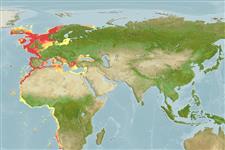
Θαλασσινό(ά) βενθικό(ς); εύρος βάθους 5 - 1020 m (Ref. 114953). Subtropical; 70°N - 38°S, 25°W - 50°E
Eastern Atlantic and Southwest Indian Ocean: Iceland to Madagascar, including the Mediterranean Sea.
Μήκος κατά την πρώτη ωρίμανση / Μέγεθος / Βάρος / Ηλικία
Γεννητική Ωρίμανση: Lm 76.6, range 47 - 87.5 cm
Max length : 105 cm TL αρσενικό/απροσδιόριστο; (Ref. 53748); 139.0 cm TL (female); common length : 85.0 cm TL αρσενικό/απροσδιόριστο; (Ref. 9987); μεγ. δημοσιευμένο βάρος: 18.0 kg (Ref. 35388); μεγ. αναφερόμενη ηλικία: 15 έτη (Ref. 41305)
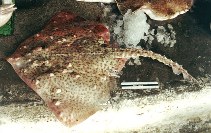
Ραχιαίες άκανθες (συνολικά) : 0; Εδρικές άκανθες: 0. Sub-rhomboid in shape with pointed wing-tips; disc-width 1,25 to 1,36 times in its length, its length 1,70 to 1,83 times in total length. Short rostrum, rounded at his extremity; pectoral fins with clear angles on lateral side; triangular pelvic fins (Ref. 39246). Dorsally prickly; large females also prickly throughout their ventral surface; juveniles and large males prickly along the margins of their discs and the underside of their snout. 30-50 thorns form a median row from the nape to the first dorsal fin; additional large 'buckler' thorns with swollen bases scattered on upper surface of disc in adults (Ref. 3167). Coloration is highly variable, with the dorsal surface having all shades of brown with dark and light spots and blotches; ventral surface white (Ref. 3167, 58137).
Body shape (shape guide): other; Cross section: flattened.
Inhabits shelf and upper slope waters. Reported depth ranges varies, from 10-300 m (Ref. 4426, 82319, 88187), and from 300-577 m in the eastern Ionian Sea (Ref. 56504); most common in coastal waters between 10-60 m depth (Ref. 58137). Tolerates low salinities (Ref. 88171). Found on mud, sand and gravel bottoms, rarely on rougher bottoms (Ref. 6808, 58137). Nocturnal species. Feeds on all kinds of bottom animals, preferably crustaceans (Ref. 3167) and fishes (Ref. 114953). Undertakes migrations with mean distances of 54-117 km per month; shows a clear annual migration cycle (Ref. 89017, 89018), moves from deeper offshore waters (10-30 m) in autumn and winter to shallower areas (<10 m) in spring (Ref. 82319). Young are non-migratory, inhabiting inshore nursery grounds (Ref. 89019, 89020, 89022); in the Bay of Douarnenez (France) they are found to remain in shallow waters for at least 2 years (Ref. 89023). Maturity age 7-8 years (Ref. 114953). Oviparous. Young may tend to follow large objects, such as their mother (Ref. 205). Detects weak electric fields generated by other organisms (prey detection and predator avoidance) but may also generate its own weak electric fields (Ref. 10311, 88171). Utilized fresh and frozen (Ref. 9987).
Oviparous. Distinct pairing with embrace. Polyandrous species (Ref. 89024). Paired eggs are laid and deposited on shallow sand, mud, pebble or gravel bottoms (Ref. 205, 89025). Up to 170 egg cases can be laid by a single female in a year (Ref. 3167), but average fecundity is much lower (around 48-74 eggs) (Ref. 3603, 31302). In northwestern Europe, egg cases are laid during spring (Ref. 3167) and in the Mediterranean during winter and spring (Ref. 3167). Egg cases are oblong capsules with stiff pointed horns at the corners, each containing one embryo (Ref. 205). Capsules are 5.0-9.0 cm long without the horns (Ref. 41250, 88187) and 3.4-6.8 cm wide (Ref. 41250). Egg cases are anchored with an adhesive film (Ref. 82399). Embryos feed solely on yolk (Ref. 50449). Egg cases hatch after about 4-5 months and pups are about 11-13 cm TL (Ref. 88864). Mating season from February to September, peaking in June (Ref. 74501). Adults observed to form same-sex aggregations during the mating season with females moving to shallower inshore waters approximately a month before the males (Ref 3603, 58137, 74501). Mating does not occur in the Baltic Sea (Ref. 82311).
McEachran, J.D. and K.A. Dunn, 1998. Phylogenetic analysis of skates, a morphologically conservative clade of elasmobranchs (Chondrichthyes: Rajidae). Copeia 1998(2):271-290. (Ref. 27314)
Κατάσταση Κόκκινου Καταλόγου IUCN (Ref. 130435: Version 2025-2 (Global))
Απειλή για τον άνθρωπο
Harmless
Ανθρώπινες χρήσεις
αλιεία: Εμπορικό(ά); αλιεία αναψυχής: ναί
Εργαλεία
Ειδικές εκθέσεις
Λήψη XML
Διαδικτυακές πηγές
Εκτιμήσεις βάσει μοντέλων
Προτιμώμενη θερμοκρασία (Αναφ.
123201): 7.1 - 15.8, mean 10.7 °C (based on 474 cells).
Δείκτης φυλογενετικής ποικιλότητας (Αναφ.
82804): PD
50 = 0.5000 [Uniqueness, from 0.5 = low to 2.0 = high].
Bayesian length-weight: a=0.00204 (0.00179 - 0.00233), b=3.26 (3.23 - 3.29), in cm total length, based on LWR estimates for this species (Ref.
93245).
Τροφικό Επίπεδο (Αναφ.
69278): 3.8 ±0.2 se; based on diet studies.
Generation time: 7.8 (5.4 - 10.4) years. Estimated as median ln(3)/K based on 16
growth studies.
Ελαστικότητα (Αναφ.
120179): Χαμηλό, ελάχιστος χρόνος για διπλασιασμό πληθυσμού 4,5 - 14 έτη (K=0.09-0.14; tm=10; tmax=23; Fec=150).
Prior r = 0.18, 95% CL = 0.12 - 0.26, Based on 4 full stock assessments.
Ευπάθεια στην αλιεία (Ref.
59153): High vulnerability (60 of 100).
🛈
Ευπάθεια στο κλίμα (Ref.
125649): High vulnerability (60 of 100).
🛈
Θρεπτικά συστατικά (Ref.
124155): Calcium = 9.22 [1.18, 176.74] mg/100g; Iron = 0.628 [0.060, 7.651] mg/100g; Protein = 17.2 [14.4, 19.5] %; Omega3 = 0.571 [0.265, 1.295] g/100g; Selenium = 39.7 [7.5, 183.1] μg/100g; VitaminA = 5.22 [0.40, 59.91] μg/100g; Zinc = 0.47 [0.03, 5.30] mg/100g (wet weight); based on
nutrient studies.