>
Cichliformes (Cichlids, convict blennies) >
Cichlidae (Cichlids) > Pseudocrenilabrinae
Etymology: Oreochromis: Latin, aurum = gold + Greek, chromis = a fish, perhaps a perch (Ref. 45335).
More on authors: Hilgendorf & Pappenheim.
Miljö: miljö / Klimatzon / djupintervall / distributionsområde
Ekologi
; sötvatten bentopelagisk. Tropical; 7°S - 9°S
Africa: Lake Rukwa (Ref. 2, 118630) and upper Great Ruaha River in Tanzania (Ref. 118630).
Storlek / Vikt / Ålder
Könsmognad: Lm ? range ? - ? cm
Max length : 33.0 cm SL hane/ej könsbestämd; (Ref. 4967)
Kort beskrivning
Bestämningsnycklar | Morfologi | Morfometri
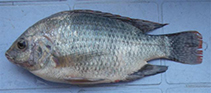
Taggstrålar i ryggfenan (totalt) : 15 - 17; Mjukstrålar i ryggfenan (totalt) : 11 - 13; Taggstrålar i analfenan: 3; Mjukstrålar i analfenan: 10 - 11; Ryggkotor: 30. Diagnosis: Typical tilapiine cichlid, relatively deep bodied, with rather a small head (Ref. 118638). Other distinguishing characters are: caudal fin free of scales except basally; vertebrae 30; scales in lateral line series 30-32; dorsal spines XV-XVII; soft rays usually 11-13; outer teeth bicuspid, in mature fishes occasionally with a few tricuspids; lower gill-rakers 20-22; interorbital region in adults 34.5-40.0% length of head (Ref. 2). Ripe males have a dark body and fins, almost black, with bright red/orange margins on the dorsal and caudal fins; vertical barring can be noticeable in freshly caught specimens; head region in ripe males has a bluish sheen; ripe males have yellow-orange tassels; females and subadult males plain silver/grey with 6-7 post-opercular vertical stripes and bluish snout present in freshly caught specimens (Ref. 118638).
Body shape (shape guide): short and / or deep; Cross section: compressed.
This species is found both in large lakes and small rivers (Ref. 4967, 118638). A maternal mouthbrooder (Ref. 118638). Males construct territories in shallow water; where there was ample space they were similar in structure and grouping to those of Oreochromis variabilis, each territory consisting of a central raised mating platform in the middle of a large circular depression (Ref. 2). It is a major component of the fisheries catch in Lake Rukwa and the Mtera Dam (Ref. 118638). Strong aquaculture potential given broad habitat requirements (Ref. 118638). IUCN conservation status is stated as vulnerable D2, declining population trend (Ref. 118638).
Livscykel och parningsbeteende
Könsmognad | Reproduktion | Lek | Ägg | Fekunditet | Larver
A maternal mouthbrooder (Ref. 118638). Males construct territories in shallow water; where there was ample space they were similar in structure and grouping to those of Oreochromis variabilis, each territory consisting of a central raised mating platform in the middle of a large circular depression; males occupy these territories at sunrise, when water temperature was 12°C and they left for deeper water in the late afternoon when the temperature rose to 25°C (Ref. 2). It exhibits pseudo-spawning and then true spawning follows (Ref. 2).
Trewavas, E., 1983. Tilapiine fishes of the genera Sarotherodon, Oreochromis and Danakilia. British Mus. Nat. Hist., London, UK. 583 p. (Ref. 2)
Status på IUCN:s rödlista (Ref. 130435: Version 2025-2 (Global))
Hot mot människor
Harmless
Mänskliga användningsområden
Fiskeri: kommersiell
Verktyg
Särskilda rapporter
Ladda ner XML
Internet-källor
Uppskattningar baserade på modeller
Index för fylogenetisk mångfald (Ref.
82804): PD
50 = 0.5000 [Uniqueness, from 0.5 = low to 2.0 = high].
Bayesian length-weight: a=0.01905 (0.00846 - 0.04293), b=3.01 (2.82 - 3.20), in cm total length, based on LWR estimates for this (Sub)family-body shape (Ref.
93245).
Resiliens (Ref.
120179): Mellan, lägsta populationsfördubblingstid 1,4-4,4 år (Preliminary K or Fecundity.).
Sårbarhet i fisket (Ref.
59153): Low to moderate vulnerability (30 of 100).
🛈