>
Cichliformes (Cichlids, convict blennies) >
Cichlidae (Cichlids) > Pseudocrenilabrinae
Etymology: Oreochromis: Latin, aurum = gold + Greek, chromis = a fish, perhaps a perch (Ref. 45335).
Eponymy: J W Graham (no other information available) collected the type in a hot soda lake in Kenya. (Ref. 128868), visit book page.
More on author: Boulenger.
Environnement : milieu / zone climatique / profondeur / gamme de distribution
Écologie
; eau douce benthopélagique; pH range: 7.5 - 8.5; dH range: 10 - 20. Tropical; 24°C - 32°C (Ref. 2060); 1°S - 2°S
Africa: Lake Magadi in Kenya (Ref. 52331). Introduced in Lake Nakuru and Lake Elmenteita, both in Kenya (Ref. 52331). Reported as introduced to Lake Natron in Tanzania (Ref. 13364), but there is currently no evidence that any introduction led to establishment of breeding populations (Ref. 118638).
Longueur à la première maturité / Taille / Poids / Âge
Maturité: Lm ?, range 3 - ? cm
Max length : 20.0 cm SL mâle / non sexé; (Ref. 2)
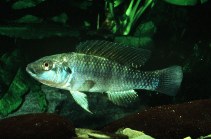
Épines dorsales (Total) : 11 - 13; Rayons mous dorsaux (Total) : 12 - 13; Épines anales: 3; Rayons mous anaux: 9 - 11; Vertèbres: 28. Mature females with an overall golden hue; males with the flanks a pale blue. Swollen and brilliant white lateral parts of the lower lip of the mature male. Blue spots on scales becoming iridescent. Genital papilla conical, prominent and yellow in the mature male; swollen in the mature female. An oblique eye-bar intensely black in the breeding male, duller in the female.
Body shape (shape guide): short and / or deep; Cross section: compressed.
Facultative air-breathing (Ref. 126274); Occur at temperatures ranging from 16.0-40.0 °C (Ref. 2). Feed actively in the evening. Young O. alcalicus grahami eat eggs as they are shed by the female, and much of the time and energy of the territorial male is occupied in driving them off. Feed on invertebrates, at the surface (Ref. 2).
Cycle de vie et comportement reproducteur
Maturité | Reproduction | Frai | Œufs | Fécondité | Larves
Male prepares a breeding pit, the structure of which may vary with the nature of the substratum. Breeding activities are more actively pursued by both sexes in the morning than in the afternoon. Female lays about 3-10 eggs at a time, picks them up instantly and the male swims with his genital papilla near the mouth, probably emitting sperm. Brooding period reportedly 12-16 days.
Seegers, L. and H. Tichy, 1999. The Oreochromis alcalicus flock (Teleostei: Cichlidae) from lakes Natron and Magadi, Tanzania and Kenya, with descriptions of two new species. Ichthyol. Explor. Freshwat. 10(2):97-146. (Ref. 32272)
Statut dans la liste rouge de l'IUCN (Ref. 130435: Version 2025-2 (Global))
Menacé (EN) (B1ab(i,ii,iii)); Date assessed: 16 June 2022
Menace pour l'homme
Harmless
Utilisations par l'homme
Aquarium: Commercial
Outils
Articles particuliers
Télécharger en XML
Sources Internet
Estimations basées sur des modèles
Indice de diversité phylogénétique (Réf.
82804): PD
50 = 0.5000 [Uniqueness, from 0.5 = low to 2.0 = high].
Bayesian length-weight: a=0.01905 (0.00846 - 0.04293), b=3.01 (2.82 - 3.20), in cm total length, based on LWR estimates for this (Sub)family-body shape (Ref.
93245).
Niveau trophique (Réf.
69278): 2.8 ±0.28 se; based on food items.
Résilience (Réf.
120179): Haut, temps minimum de doublement de population inférieur à 15 mois (Preliminary K or Fecundity.).
Vulnérabilité de la pêche (Ref.
59153): Low vulnerability (14 of 100).
🛈