>
Gadiformes (Cods) >
Moridae (Morid cods)
Etymology: Halargyreus: Greek, als = salt + Greek, argyros = silver (Ref. 45335).
Eponymy: James Yate Johnson (1820–1900) was a British naturalist who moved to Madeira (1851) and spent the rest of his life there. [...] (Ref. 128868), visit book page.
More on author: Günther.
Milieu: milieu / Klimaatzone / Diepte / verspreidingsgebied
Ecologie
marien bathypelagisch; diepte 450 - 3000 m (Ref. 50550). Deep-water; 67°N - 60°S, 86°W - 122°W (Ref. 1371)
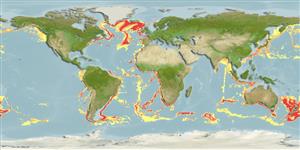
Spotty records from the subarctic and subantarctic to temperate waters of the Atlantic Ocean. South Atlantic: along the coast of Africa, on Walvis Ridge, near Discovery and Meteor seamounts and on the continental slope of Antarctica (Ref. 44938). Northwest Atlantic: Canada (Ref. 5951). North Pacific: northwestern Bering Sea and the Pacific Ocean south of the Gulf of Alaska to California and to Japan and the Sea of Okhotsk.
Grootte / Gewicht / Leeftijd
Maturiteit: Lm ? range ? - ? cm
Max length : 56.0 cm TL mannelijk / geslacht onbekend; (Ref. 1371)
Korte beschrijving
Determinatiesleutels | Morfologie | Morfometrie
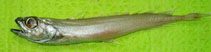
Dorsale stekels (totaal) : 0; Dorsale zachte stralen (totaal) : 58 - 67; Anale stekels: 0; Anale zachte stralen: 42 - 53; Wervels: 52 - 55. Eye large, its diameter about equal to snout length. Lower jaw slightly projecting; chin barbel absent. Elongate filament in first dorsal fin absent. Anal fin originating at about the midlength of body, deeply indented; pectoral fins not reaching to anal fin origin. Outer 2 pelvic rays elongate. Anterior gill rakers of 1st arch longer than gill filaments. Ventral light organ absent. Color is generally pale, silvery in fresh specimen; urobranchial cavity black (Refs. 1371, 43939).
Body shape (shape guide): elongated; Cross section: compressed.
Epibenthic (Ref. 58426). Food consists of free-living small animals, such as crustaceans and squids. This species is reportedly being caught by trawl in temperate waters of Australia (Ref. 9563).
Levenscyclus en paargedrag
Maturiteit | Voortplanting | Paaien | Eieren | Fecunditeit | Larven
Cohen, D.M., T. Inada, T. Iwamoto and N. Scialabba, 1990. FAO species catalogue. Vol. 10. Gadiform fishes of the world (Order Gadiformes). An annotated and illustrated catalogue of cods, hakes, grenadiers and other gadiform fishes known to date. FAO Fish. Synop. 125(10). Rome: FAO. 442 p. (Ref. 1371)
Status op de Rode Lijst van het IUCN (Ref. 130435: Version 2025-2 (Global))
Gevaar voor de mens
Harmless
Gebruik door de mens
Visserij: commercieel
Tools
Speciale rapporten
Download XML
Internetbronnen
Schattingen op basis van modellen
Gewenste temperatuur (Ref.
123201): 0.2 - 7.1, mean 3.7 °C (based on 813 cells).
Fylogenetische diversiteitsindex (Ref.
82804): PD
50 = 1.0000 [Uniqueness, from 0.5 = low to 2.0 = high].
Bayesian length-weight: a=0.00389 (0.00193 - 0.00783), b=3.11 (2.93 - 3.29), in cm total length, based on LWR estimates for this (Sub)family-body shape (Ref.
93245).
Trofisch niveau (Ref.
69278): 3.4 ±0.47 se; based on food items.
Weerstandsvermogen (Ref.
120179): Zeer laag, minimale populatieverdubbelingstijd meer dan 14 jaar (Preliminary K or Fecundity.).
Kwetsbaarheid van de visserij (Ref.
59153): Moderate vulnerability (42 of 100).
🛈
Kwetsbaarheid voor het klimaat (Ref.
125649): Low vulnerability (11 of 100).
🛈
Voedingsstoffen (Ref.
124155): Calcium = 24.8 [7.6, 57.6] mg/100g; Iron = 0.326 [0.144, 0.931] mg/100g; Protein = 17.3 [15.6, 19.1] %; Omega3 = 0.115 [0.044, 0.294] g/100g; Selenium = 23.4 [7.2, 63.4] μg/100g; VitaminA = 32.9 [4.2, 273.0] μg/100g; Zinc = 0.528 [0.283, 1.067] mg/100g (wet weight);