Umwelt: Milieu / Klimazone / Tiefenbereich / Verbreitungsgebiet
Ökologie
seewasser; brackwasser pelagic-oceanic; tiefenbereich 22 - 500 m (Ref. 58489), usually ? - 150 m (Ref. 9072). Subtropical; 23°S - 50°S, 112°E - 176°W
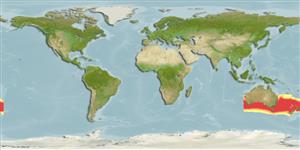
Southwest Pacific: Australia and New Zealand waters. Two subpopulations probably exist in the Great Australian Bight and southeastern Australia, respectively, and two species or subspecies in the southeastern group (Ref. 7456).
Länge bei der ersten Reifung / Größe / Gewicht / Alter
Geschlechtsreife: Lm 20.0 range ? - ? cm
Max length : 50.0 cm SL Männchen/unbestimmt; (Ref. 33839); common length : 35.0 cm TL Männchen/unbestimmt; (Ref. 9258); max. veröff. Alter: 25 Jahre (Ref. 9072)
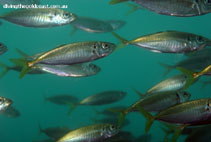
Rückenflossenstacheln (insgesamt) : 9; Rückenflossenweichstrahlen (insgesamt) : 27 - 33; Afterflossenstacheln: 3; Afterflossenweichstrahlen: 22 - 29; Wirbelzahl: 24. Adults are elongate and compressed, and have a primary lateral line with 67-81 scutes, a secondary lateral line reaching to dorsal-fin ray 2, and a yellow caudal fin.
Body shape (shape guide): fusiform / normal.
Adults occur in coastal waters, including estuaries (Ref. 9563), mostly in waters shallower than 150 m and warmer than 13°C (Ref. 9072). Commonly found on the bottom, in midwater and occasionally at the surface (Ref. 9258), in large schools (Ref. 33616). Adults are generally found over offshore rocky reefs, while juveniles are generally found in shallow, soft substrate areas (Ref. 6390). Utilized fresh, smoked, canned and frozen; can be fried, broiled and baked (Ref. 9988).
Paxton, J.R., D.F. Hoese, G.R. Allen and J.E. Hanley, 1989. Pisces. Petromyzontidae to Carangidae. Zoological Catalogue of Australia, Vol. 7. Australian Government Publishing Service, Canberra, 665 p. (Ref. 7300)
IUCN Rote Liste Status (Ref. 130435: Version 2025-2 (Global))
Bedrohung für Menschen
Harmless
Nutzung durch Menschen
Fischereien: kommerziell; Sportfisch: ja; Köder: usually
Tools
Zusatzinformationen
Download XML
Internet Quellen
Schätzungen auf der Grundlage von Modellen
Bevorzugte Temperatur (Ref.
123201): 13.1 - 21.2, mean 15.3 °C (based on 70 cells).
Phylogenetischer Diversitätsindex (Ref.
82804): PD
50 = 0.5001 [Uniqueness, from 0.5 = low to 2.0 = high].
Bayesian length-weight: a=0.01738 (0.01002 - 0.03014), b=2.99 (2.84 - 3.14), in cm total length, based on LWR estimates for this species & Genus-body shape (Ref.
93245).
Trophische Ebene (Ref.
69278): 3.2 ±0.40 se; based on food items.
Generation time: 3.7 ( na - na) years. Estimated as median ln(3)/K based on 2
growth studies.
Widerstandsfähigkeit (Ref.
120179): mittel, Verdopplung der Population dauert 1,4 - 4,4 Jahre. (K=0.30; tm=3-4; tmax=25).
Anfälligkeit der Fischerei (Ref.
59153): Moderate vulnerability (37 of 100).
🛈
Nährstoffe (Ref.
124155): Calcium = 263 [161, 434] mg/100g; Iron = 3.76 [2.23, 6.42] mg/100g; Protein = 19.8 [19.0, 20.5] %; Omega3 = 0.383 [0.249, 0.578] g/100g; Selenium = 26.8 [14.7, 49.8] μg/100g; VitaminA = 8.05 [2.13, 29.13] μg/100g; Zinc = 2.37 [1.72, 3.33] mg/100g (wet weight);