>
Carangiformes (Jacks) >
Carangidae (Jacks and pompanos) > Naucratinae
Etymology: Seriolina: Latin word diminutive with the meaning of a large earthenware pot (Ref. 45335).
More on author: Rüppell.
Ambiente: milieu / zona climatica / distribuzione batimetrica / gamma di distribuzione
Ecologia
marino; salmastro associati a barriera corallina; distribuzione batimetrica 20 - 150 m (Ref. 30573). Tropical; 38°N - 35°S, 20°E - 163°E
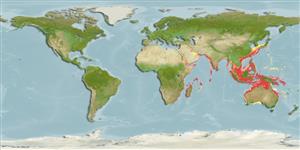
Southeast Atlantic: southeast coast of South Africa (Ref. 3197). Indo-West Pacific: Red Sea and East Africa to Japan, Australia and Solomon Island.
Dimensione / Peso / Età
Maturità: Lm ? range ? - ? cm
Max length : 77.5 cm TL maschio/sesso non determinato; (Ref. 30504); common length : 50.0 cm TL maschio/sesso non determinato; (Ref. 5450); peso massimo pubblicato: 5.2 kg (Ref. 3287)
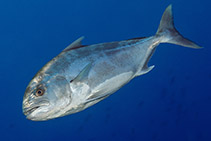
Spine dorsali (totale) : 8 - 9; Raggi dorsali molli (totale) : 30 - 37; Spine anali: 2; Raggi anali molli: 15 - 18. Color bluish grey to black dorsally, white to dusky below; 5-7 dark oblique bands or blotches on young disappear with age. Posterior spines of dorsal fin minute or embedded in large adults; first anal spine usually embedded. Gill rakers are mostly rudiments. Grooves of caudal peduncle present dorsally and ventrally. Maxilla reaching below rear margin of the eyes.
Body shape (shape guide): short and / or deep; Cross section: compressed.
Mainly in offshore reefs on the continental shelf (Ref. 30573, 48635), on rocky bottoms (Ref. 11230). Non-schooling. Juveniles under weed rafts and adults are sometimes seen with the large planktivores such as whale sharks (Ref. 48635). Adults feed on demersal fishes, cephalopods, and shrimp (Ref. 11441). Excellent food fish (Ref. 3197); marketed fresh and dried salted (Ref. 3287).
Ciclo vitale e comportamento di accoppiamento
Maturità | Riproduzione | Deposizione | Uova | Fecondità | Larve
Paxton, J.R., D.F. Hoese, G.R. Allen and J.E. Hanley, 1989. Pisces. Petromyzontidae to Carangidae. Zoological Catalogue of Australia, Vol. 7. Australian Government Publishing Service, Canberra, 665 p. (Ref. 7300)
Stato della Lista Rossa IUCN (Ref. 130435: Version 2025-2 (Global))
Minaccia per l'uomo
Harmless
Usi umani
Pesca: scarso interesse commerciale; Pesce da pesca sportiva: si
Strumenti
Rapporti speciali
Scarica XML
Fonti Internet
Stime basate su modelli
Temperatura preferita (Fonte Biblio.
123201): 21.9 - 28.3, mean 27 °C (based on 911 cells).
Indice di diversità filogenetica (Fonte Biblio.
82804): PD
50 = 1.0000 [Uniqueness, from 0.5 = low to 2.0 = high].
Bayesian length-weight: a=0.02344 (0.01159 - 0.04740), b=2.93 (2.74 - 3.12), in cm total length, based on LWR estimates for this species & (Sub)family-body (Ref.
93245).
Livello trofico (Fonte Biblio.
69278): 4.2 ±0.57 se; based on food items.
Resilienza (Fonte Biblio.
120179): Medio, tempo minimo di raddoppiamento della popolazione 1.4 - 4.4 anni (Assuming tm=2-4).
Vulnerabilità della pesca (Ref.
59153): Moderate to high vulnerability (51 of 100).
🛈
Vulnerabilità climatica (Ref.
125649): High vulnerability (61 of 100).
🛈
Nutrienti (Ref.
124155): Calcium = 38.8 [16.6, 67.1] mg/100g; Iron = 0.608 [0.325, 1.237] mg/100g; Protein = 19 [17, 21] %; Omega3 = 0.136 [0.080, 0.257] g/100g; Selenium = 45.2 [22.4, 89.8] μg/100g; VitaminA = 33 [8, 136] μg/100g; Zinc = 0.815 [0.528, 1.203] mg/100g (wet weight); based on
nutrient studies.