>
Eupercaria/misc (Various families in series Eupercaria) >
Lutjanidae (Snappers) > Apsilinae
Etymology: Paracaesio: Greek, para = the side of + Latin, caesium = bluish grey (Ref. 45335).
More on author: Bleeker.
Environnement : milieu / zone climatique / profondeur / gamme de distribution
Écologie
marin récifal; profondeur 5 - 250 m (Ref. 86942). Tropical; 35°N - 35°S, 37°E - 169°W (Ref. 55)
Indo-Pacific: East Africa to the Austral Islands, north to southern Japan, south to southeastern Australia. Paracaesio xanthura, a complex of variable populations, may compose a single or two (or more) species. Paracaesio pedleyi, from Lord Howe Island, Middleton Reef, and eastern Australian waters, is included here with some reservation (Ref. 9821).
Taille / Poids / Âge
Maturité: Lm ? range ? - ? cm
Max length : 50.0 cm TL mâle / non sexé; (Ref. 5484)
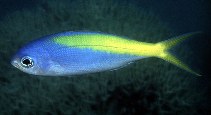
Épines dorsales (Total) : 10; Rayons mous dorsaux (Total) : 10 - 11; Épines anales: 3; Rayons mous anaux: 8 - 9. This species is distinguished by the following characters: body relatively deep and laterally compressed, greatest body depth 2.5-2.8 in SL; interorbital region convex; mouth terminal, jaws about equal; anterior end of upper lip without a thick fleshy protrusion; maxilla with or without scales and without longitudinal ridges; teeth in jaws caniniform to villiform; gill rakers of first gill arch 5-11 + 18-20; soft rays of dorsal fin usually 10, in anal fin 8; lateral line scales 70-72; caudal fin forked. Colour bright blue; broad yellow band over most of dorsal half of body, including most of caudal pedincle fin (Ref. 9821, 90102).
Body shape (shape guide): fusiform / normal; Cross section: oval.
Adults occur over rocky bottoms, sometimes forming large schools. They feed largely on zooplankton (Ref. 30573). Caught mainly with handlines and bottom longlines and marketed fresh or frozen (Ref. 9821).
Cycle de vie et comportement reproducteur
Maturité | Reproduction | Frai | Œufs | Fécondité | Larves
Allen, G.R., 1985. FAO Species Catalogue. Vol. 6. Snappers of the world. An annotated and illustrated catalogue of lutjanid species known to date. FAO Fish. Synop. 125(6):208 p. Rome: FAO. (Ref. 55)
Statut dans la liste rouge de l'IUCN (Ref. 130435: Version 2025-2 (Global))
Menace pour l'homme
Harmless
Utilisations par l'homme
Pêcheries: commercial; pêche sportive: oui
Outils
Articles particuliers
Télécharger en XML
Sources Internet
Estimations basées sur des modèles
Température préférée (Réf.
123201): 19.9 - 28.3, mean 26.5 °C (based on 1214 cells).
Indice de diversité phylogénétique (Réf.
82804): PD
50 = 0.5039 [Uniqueness, from 0.5 = low to 2.0 = high].
Bayesian length-weight: a=0.01905 (0.01027 - 0.03536), b=3.08 (2.91 - 3.25), in cm total length, based on LWR estimates for this species & (Sub)family-body (Ref.
93245).
Niveau trophique (Réf.
69278): 3.4 ±0.45 se; based on food items.
Résilience (Réf.
120179): Milieu, temps minimum de doublement de population : 1,4 à 4,4 années (Preliminary K or Fecundity.).
Vulnérabilité de la pêche (Ref.
59153): Moderate vulnerability (40 of 100).
🛈
Nutriments (Ref.
124155): Calcium = 35.2 [20.5, 63.3] mg/100g; Iron = 0.611 [0.323, 0.987] mg/100g; Protein = 18.6 [16.7, 20.3] %; Omega3 = 0.152 [0.096, 0.241] g/100g; Selenium = 46.7 [28.3, 84.0] μg/100g; VitaminA = 105 [37, 345] μg/100g; Zinc = 0.993 [0.700, 1.369] mg/100g (wet weight);