>
Carangiformes (Jacks) >
Carangidae (Jacks and pompanos) > Caranginae
Etymology: Caranx: French, carangue, the name of a Caribbean fish; 1836 (Ref. 45335).
More on author: Poey.
Ambiente: milieu / zona climatica / distribuzione batimetrica / gamma di distribuzione
Ecologia
marino benthopelagico; oceanodromo (Ref. 51243); distribuzione batimetrica 12 - 354 m (Ref. 9710), usually 24 - 65 m (Ref. 5217). Subtropical; 30°N - 30°S, 180°W - 180°E
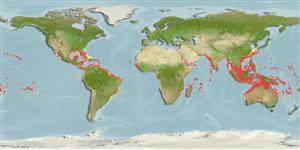
Circumtropical. Western Indian Ocean: off Natal and East London in South Africa (Ref. 3197, 11228); Reunion, Mauritius and Cargados Carajos (Ref. 33390); Seychelles (Ref. 10685). Western Pacific: southern Japan to New Caledonia. Recently reported from Tonga (Ref. 53797). Western Atlantic: Bermuda and the northern Gulf of Mexico to Brazil. Eastern Atlantic: Azores, Madeira, St. Paul's Rocks (Ref. 13121), Ascension Island, Cape Verde, and Gulf of Guinea. Eastern Central Pacific: Mexico (including Revillagigedo Islands) to Costa Rica.
Lunghezza alla prima maturità / Dimensione / Peso / Età
Maturità: Lm ?, range 38 - ? cm
Max length : 100.0 cm TL maschio/sesso non determinato; (Ref. 7251); common length : 70.0 cm TL maschio/sesso non determinato; (Ref. 5217); peso massimo pubblicato: 17.9 kg (Ref. 40637); Età massima riportata: 12 anni (Ref. 82366)
Spine dorsali (totale) : 9; Raggi dorsali molli (totale) : 20 - 22; Spine anali: 3; Raggi anali molli: 16 - 19.
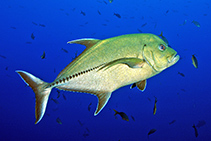
Body shape (shape guide): fusiform / normal; Cross section: compressed.
An oceanic and insular species, very much restricted to clear oceanic waters (Ref. 9283). Not commonly found in shallow banks (Ref. 9283). Sometimes seen near drop-off at outer edge of reefs (Ref. 26938). Occasionally forming schools. Adults feed on fishes at night (Ref. 5213). Eggs are pelagic (Ref. 4233). Marketed mainly fresh, also dried or salted (Ref. 9283).
Ciclo vitale e comportamento di accoppiamento
Maturità | Riproduzione | Deposizione | Uova | Fecondità | Larve
Paxton, J.R., D.F. Hoese, G.R. Allen and J.E. Hanley, 1989. Pisces. Petromyzontidae to Carangidae. Zoological Catalogue of Australia, Vol. 7. Australian Government Publishing Service, Canberra, 665 p. (Ref. 7300)
Stato della Lista Rossa IUCN (Ref. 130435: Version 2025-2 (Global))
Minaccia per l'uomo
Reports of ciguatera poisoning (Ref. 9710)
Usi umani
Pesca: scarso interesse commerciale; Acquacoltura: commerciale; Pesce da pesca sportiva: si
Strumenti
Rapporti speciali
Scarica XML
Fonti Internet
Stime basate su modelli
Temperatura preferita (Fonte Biblio.
123201): 21 - 28.4, mean 27.1 °C (based on 1117 cells).
Indice di diversità filogenetica (Fonte Biblio.
82804): PD
50 = 0.5000 [Uniqueness, from 0.5 = low to 2.0 = high].
Bayesian length-weight: a=0.01738 (0.01452 - 0.02080), b=2.96 (2.93 - 2.99), in cm total length, based on LWR estimates for this species (Ref.
93245).
Livello trofico (Fonte Biblio.
69278): 4.5 ±0.8 se; based on diet studies.
Generation time: 9.2 ( na - na) years. Estimated as median ln(3)/K based on 1
growth studies.
Resilienza (Fonte Biblio.
120179): Basso, tempo minimo di raddoppiamento della popolazione 4.5 - 14 anni (K=0.12; assumed tm=5).
Prior r = 0.27, 95% CL = 0.18 - 0.41, Based on 1 data-limited stock assessment.
Vulnerabilità della pesca (Ref.
59153): High vulnerability (60 of 100).
🛈
Nutrienti (Ref.
124155): Calcium = 18.6 [8.7, 42.6] mg/100g; Iron = 0.471 [0.233, 0.996] mg/100g; Protein = 19.2 [16.8, 21.7] %; Omega3 = 0.326 [0.167, 0.626] g/100g; Selenium = 49.4 [20.4, 117.3] μg/100g; VitaminA = 20.6 [5.9, 67.4] μg/100g; Zinc = 0.309 [0.207, 0.482] mg/100g (wet weight);