>
Eupercaria/misc (Various families in series Eupercaria) >
Lutjanidae (Snappers) > Apsilinae
Etymology: Paracaesio: Greek, para = the side of + Latin, caesium = bluish grey (Ref. 45335).
Eponymy: Robert Stone caught two specimens of this new species in Fiji (1981). Nothing more is said in the original text, but presumably this is the same Robert Stone as the Pacific Islands Forum Fisheries Agency (FFA) Development Advisor of that name. (Ref. 128868), visit book page.
Ambiente: milieu / zona climática / intervalo de profundidade / gama de distribuição
Ecologia
marinhas batidemersal; intervalo de profundidade 200 - 320 m (Ref. 9821), usually 200 - 250 m (Ref. 82366). Deep-water; 32°N - 22°S, 124°E - 177°W (Ref. 55)
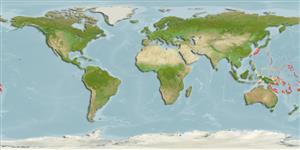
Western Pacific: off the Ryukyu Islands to northeastern Australia and Samoa.
Comprimento na primeira maturidade / Tamanho / Peso / Idade
Maturidade: Lm 40.0 range ? - ? cm
Max length : 50.0 cm SL macho/indeterminado; (Ref. 9821); Idade máx. registada: 15 anos (Ref. 82366)
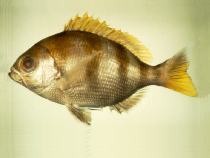
Espinhos dorsais (total) : 10; Raios dorsais moles (total) : 10; Espinhos anais: 3; Raios anais moles: 8. Eye large; snout short (shorter than eye diameter). Interorbital space slightly convex. Lower jaw protruding slightly. Scale rows on back parallel to lateral line. Pectoral fins long, reaching level of anus. Back and upper sides light brown, silvery on lower sides and belly; five brown vertical bars on the upper side; the fins are gray to whitish; the margin of the dorsal fin and most of the caudal fin yellow.
Body shape (shape guide): short and / or deep; Cross section: oval.
Adults are found on the continental shelf and continental slope (Ref. 75154).
Ciclo de vida e comportamento de acasalamento
Maturidade | Reprodução | Desova | Ovos | Fecundidade | Larvas
Allen, G.R., 1985. FAO Species Catalogue. Vol. 6. Snappers of the world. An annotated and illustrated catalogue of lutjanid species known to date. FAO Fish. Synop. 125(6):208 p. Rome: FAO. (Ref. 55)
Categoria na Lista Vermelha da IUCN (Ref. 130435: Version 2025-2 (Global))
Ameaça para o homem
Harmless
Utilização humana
Pescarias: pescarias de subsistência
Ferramentas
Relatórios especiais
Descarregue XML
Fontes da internet
Estimativas baseadas em modelos
Temperatura preferida (Ref.
123201): 18.3 - 21.1, mean 18.9 °C (based on 7 cells).
Índice de diversidade filogenética (Ref.
82804): PD
50 = 0.5039 [Uniqueness, from 0.5 = low to 2.0 = high].
Bayesian length-weight: a=0.03388 (0.01559 - 0.07364), b=2.89 (2.69 - 3.09), in cm total length, based on LWR estimates for this species & (Sub)family-body (Ref.
93245).
Nível Trófico (Ref.
69278): 4.0 ±0.66 se; based on food items.
Generation time: 5.5 ( na - na) years. Estimated as median ln(3)/K based on 1
growth studies.
Resiliência (Ref.
120179): Baixo, tempo mínimo de duplicação da população 4,5 - 14 anos (K=0.19-0.39; tmax=15).
Vulnerabilidade da pesca (Ref.
59153): Moderate to high vulnerability (50 of 100).
🛈
Nutrientes (Ref.
124155): Calcium = 21.2 [10.2, 51.2] mg/100g; Iron = 0.38 [0.14, 0.88] mg/100g; Protein = 17.4 [15.4, 19.3] %; Omega3 = 0.297 [0.134, 0.609] g/100g; Selenium = 15.8 [6.7, 37.8] μg/100g; VitaminA = 8.28 [1.38, 57.57] μg/100g; Zinc = 0.325 [0.204, 0.511] mg/100g (wet weight);