>
Carangiformes (Jacks) >
Carangidae (Jacks and pompanos) > Caranginae
Etymology: Caranx: French, carangue, the name of a Caribbean fish; 1836 (Ref. 45335).
More on author: Cuvier.
Miljö: miljö / Klimatzon / djupintervall / distributionsområde
Ekologi
marina; brackvatten revassocierade; djupintervall 0 - 190 m (Ref. 9710). Tropical; 35°N - 35°S, 30°E - 78°W
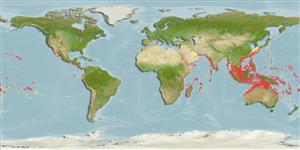
Indo-Pacific: Red Sea and East Africa to Ducie Island, north to the Ryukyu Islands, south to New Caledonia. Eastern Central Pacific: Mexico to Panama (Ref. 9283). Hybrid with Caranx sexfasciatus found in Hawaii (Ref. 58422).
Längd vid första mognad / Storlek / Vikt / Ålder
Könsmognad: Lm 35.0 range ? - ? cm
Max length : 117 cm FL hane/ej könsbestämd; (Ref. 40637); common length : 60.0 cm TL hane/ej könsbestämd; (Ref. 3280); publicerad maxvikt: 43.5 kg (Ref. 4699)
Taggstrålar i ryggfenan (totalt) : 9; Mjukstrålar i ryggfenan (totalt) : 21 - 24; Taggstrålar i analfenan: 3; Mjukstrålar i analfenan: 17 - 21; Ryggkotor: 24. This species is distinguished by the following characters: gill rakers (including rudiments) 5-9 + 17-21 = 25-29 (usually 26-27); breast completely scaly; straight part of lateral line with 0-10 anterior scales followed by 27-42 strong scutes; adipose eyelid weakly developed, small anteriorly, posterior adipose eyelid extends onto eye to rear border of pupil in large adults; upper jaw with outer row of strong canines widely spaced in adults, and an inner band of small villiform teeth, widest at symphysis; lower limb of first gill arch jaw with a single row of strong
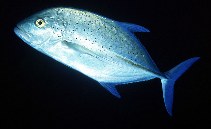
conical teeth widely spaced in adults. Colour of adults with head and dorsal half of body brassy, suffused with blue, and covered with small blue black spots (forming at about 16 to 22 cm fork length and increasing in number with size); second dorsal, anal, and caudal fins electric blue; juveniles and young adults, head and body silvery grey and fins pale to dark dusky, except pectoral fins yellow (Ref. 9894, 90102).
Body shape (shape guide): fusiform / normal; Cross section: compressed.
The most common trevally in coral reefs occurring singly or occasionally in schools (Ref. 90102). Adults are pelagic in coastal and oceanic waters, associated with reefs (Ref. 9283, 58302). Juveniles occur seasonally in shallow sandy inshore waters (Ref. 9710) and rivers (Ref. 12792). Adults feed mainly on other fishes (Ref. 9283) and crustaceans (Ref. 9710). They are often toxic when length reaches more than 50 cm (Ref. 4795). Mainly marketed fresh, but also dried or salted (Ref. 9283). They are caught primarily on hook-and-line and by spearing; also with traps and gill nets. An excellent sports fish (Ref. 9894).
Paxton, J.R., D.F. Hoese, G.R. Allen and J.E. Hanley, 1989. Pisces. Petromyzontidae to Carangidae. Zoological Catalogue of Australia, Vol. 7. Australian Government Publishing Service, Canberra, 665 p. (Ref. 7300)
Status på IUCN:s rödlista (Ref. 130435: Version 2025-2 (Global))
Hot mot människor
Reports of ciguatera poisoning (Ref. 4690)
Mänskliga användningsområden
Fiskeri: kommersiell; Vattenbruk: kommersiell; sportfisk: ja; Akvarium: Offentliga akvarier
Verktyg
Särskilda rapporter
Ladda ner XML
Internet-källor
Uppskattningar baserade på modeller
Önskad temperatur (Ref.
123201): 23.2 - 29, mean 27.9 °C (based on 2624 cells).
Index för fylogenetisk mångfald (Ref.
82804): PD
50 = 0.5000 [Uniqueness, from 0.5 = low to 2.0 = high].
Bayesian length-weight: a=0.01698 (0.01408 - 0.02048), b=2.96 (2.93 - 2.99), in cm total length, based on LWR estimates for this species (Ref.
93245).
Trofisk nivå (Ref.
69278): 4.5 ±0.8 se; based on diet studies.
Resiliens (Ref.
120179): Mellan, lägsta populationsfördubblingstid 1,4-4,4 år (K=0.17=0.23; tm=2; Fec=49,700).
Prior r = 0.69, 95% CL = 0.45 - 1.03, Based on 3 data-limited stock assessments.
Sårbarhet i fisket (Ref.
59153): High vulnerability (59 of 100).
🛈
Sårbarhet för klimatet (Ref.
125649): High to very high vulnerability (75 of 100).
🛈
Näringsämnen (Ref.
124155): Calcium = 14.7 [6.6, 29.0] mg/100g; Iron = 0.319 [0.174, 0.619] mg/100g; Protein = 20.3 [18.0, 22.7] %; Omega3 = 0.142 [0.084, 0.238] g/100g; Selenium = 56.3 [27.9, 115.0] μg/100g; VitaminA = 62.9 [18.4, 209.2] μg/100g; Zinc = 0.451 [0.325, 0.642] mg/100g (wet weight); based on
nutrient studies.