>
Carangiformes (Jacks) >
Carangidae (Jacks and pompanos) > Caranginae
Etymology: Caranx: French, carangue, the name of a Caribbean fish; 1836 (Ref. 45335).
More on author: Günther.
Miljö: miljö / Klimatzon / djupintervall / distributionsområde
Ekologi
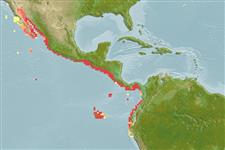
marina; brackvatten pelagic-oceanic; havsvandrande (Ref. 51243); djupintervall 1 - 350 m (Ref. 9283). Subtropical; 33°N - 7°S, 119°W - 76°W
Eastern Pacific: San Diego, California, USA to Peru, including the Gulf of California and the Galapagos Islands. Probably the same species as Caranx hippos in the Atlantic.
Storlek / Vikt / Ålder
Könsmognad: Lm ? range ? - ? cm
Max length : 101 cm FL hane/ej könsbestämd; (Ref. 40637); common length : 60.0 cm TL hane/ej könsbestämd; (Ref. 9283); publicerad maxvikt: 17.7 kg (Ref. 40637); rapporterad maxålder: 15 år (Ref. 98594)
Kort beskrivning
Bestämningsnycklar | Morfologi | Morfometri
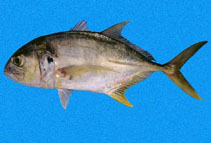
Body deep, elongated and slightly compressed; eye with an adipose eyelid; posterior edge of lower jaw behind posterior edge of eye; chest mostly scaleless, just a small patch in front of pectoral fins; 35 to 42 strong scutes; back of body blue to blue black; belly white, silvery, or yellow; pectoral fins and operculum each with a black spot (Ref. 55763).
Body shape (shape guide): fusiform / normal.
Adults occur in oceanic and coastal waters, commonly found in shallow water, with larger individuals up to 350 m depth (Ref. 9283). Also found in brackish water and occasionally ascend rivers (Ref. 9283). They form medium-sized to big schools, but large adults may be solitary (Ref. 9283). They feed mainly on fishes, but also takes shrimps and other invertebrates (Ref. 9283). Often makes a grunting sound when captured (Ref. 9283). Juveniles are often found in river estuaries (Ref. 9283). Marketed fresh, frozen, smoked and salted or dried; also utilized as fishmeal and a source of oil (Ref. 9283).
Livscykel och parningsbeteende
Könsmognad | Reproduktion | Lek | Ägg | Fekunditet | Larver
Eschmeyer, W.N., E.S. Herald and H. Hammann, 1983. A field guide to Pacific coast fishes of North America. Boston (MA, USA): Houghton Mifflin Company. xii+336 p. (Ref. 2850)
Status på IUCN:s rödlista (Ref. 130435: Version 2025-2 (Global))
Hot mot människor
Harmless
Mänskliga användningsområden
Fiskeri: kommersiell; sportfisk: ja
Verktyg
Särskilda rapporter
Ladda ner XML
Internet-källor
Uppskattningar baserade på modeller
Önskad temperatur (Ref.
123201): 12.9 - 21.7, mean 15.7 °C (based on 68 cells).
Index för fylogenetisk mångfald (Ref.
82804): PD
50 = 0.5000 [Uniqueness, from 0.5 = low to 2.0 = high].
Bayesian length-weight: a=0.01445 (0.00923 - 0.02264), b=2.95 (2.83 - 3.07), in cm total length, based on LWR estimates for this species & Genus-body shape (Ref.
93245).
Trofisk nivå (Ref.
69278): 3.9 ±0.61 se; based on food items.
Generation time: 5.4 ( na - na) years. Estimated as median ln(3)/K based on 2
growth studies.
Resiliens (Ref.
120179): Mellan, lägsta populationsfördubblingstid 1,4-4,4 år (K=0.2; assumed tm=2.4; tmax=15).
Sårbarhet i fisket (Ref.
59153): Moderate to high vulnerability (47 of 100).
🛈
Näringsämnen (Ref.
124155): Calcium = 28.6 [11.4, 60.7] mg/100g; Iron = 0.665 [0.328, 1.382] mg/100g; Protein = 20.4 [18.1, 22.9] %; Omega3 = 0.388 [0.210, 0.722] g/100g; Selenium = 35.6 [15.3, 84.4] μg/100g; VitaminA = 7.38 [2.23, 21.63] μg/100g; Zinc = 0.416 [0.252, 0.668] mg/100g (wet weight);