>
Carangiformes (Jacks) >
Carangidae (Jacks and pompanos) > Caranginae
Etymology: Caranx: French, carangue, the name of a Caribbean fish; 1836 (Ref. 45335).
Eponymy: Reginald Heber (1783–1826) was an English cleric, poet, man of letters and hymn writer who became Bishop of Calcutta. [...] (Ref. 128868), visit book page.
Milieu: milieu / Klimaatzone / Diepte / verspreidingsgebied
Ecologie
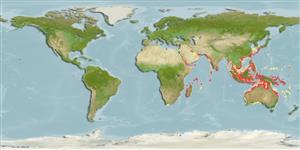
marien; brak water rifbewoner; standvastig. Tropical; 34°N - 39°S, 19°E - 168°E
Indo-West Pacific: East Africa and Madagascar to Fiji, north to the Ryukyu Islands, south to northern Australia.
Lengte bij maturiteit / Grootte / Gewicht / Leeftijd
Maturiteit: Lm 50.0 range ? - ? cm
Max length : 88.0 cm TL mannelijk / geslacht onbekend; (Ref. 90102); common length : 30.0 cm TL mannelijk / geslacht onbekend; (Ref. 5450); max. gepubliceerd gewicht: 12.5 kg (Ref. 11228)
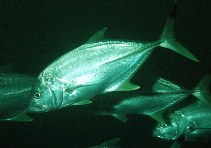
Dorsale stekels (totaal) : 9; Dorsale zachte stralen (totaal) : 19 - 21; Anale stekels: 3; Anale zachte stralen: 15 - 17. Dark bronze to yellow-green dorsally, shading to silvery bronze to yellowish or yellow green ventrally (Ref. 48635, 90102), yellow to dusky caudal fin and usually outer half of upper caudal lobe black (especially in juvenile) (Ref. 90102). Identified by black-tipped caudal fin (Ref. 48635). Body oblong and compressed, dorsal profile strongly convex to second dorsal fin, ventral profile slightly convex. Breast scalation variable, completely scaly (uncommon) to scaleless ventrally (Ref. 90102). LL with 30-40 strong scutes (Ref. 48635, 90102). Adipose eyelid moderately developed, small anteriorly and extending forward to rear edge of pupil o posterior part of eye. (Ref. 90102)
Body shape (shape guide): fusiform / normal; Cross section: compressed.
Adults inhabit clear coastal waters, over rocky reefs in small aggregations (Ref. 5213). Seldom found in turbid or estuarine waters. May be found solitary (Ref. 90102). They feed on fishes and crustaceans (Ref. 5213). Sold fresh and dried salted in markets. Excellent food fish if cooked properly (Ref. 12484).
Levenscyclus en paargedrag
Maturiteit | Voortplanting | Paaien | Eieren | Fecunditeit | Larven
Fricke, R., 1999. Fishes of the Mascarene Islands (Réunion, Mauritius, Rodriguez): an annotated checklist, with descriptions of new species. Koeltz Scientific Books, Koenigstein, Theses Zoologicae, Vol. 31:759 p. (Ref. 33390)
Status op de Rode Lijst van het IUCN (Ref. 130435: Version 2025-2 (Global))
Gevaar voor de mens
Harmless
Gebruik door de mens
Visserij: van minder commercieel belang; sportvis: ja
Tools
Speciale rapporten
Download XML
Internetbronnen
Schattingen op basis van modellen
Gewenste temperatuur (Ref.
123201): 23.9 - 29, mean 27.9 °C (based on 1214 cells).
Fylogenetische diversiteitsindex (Ref.
82804): PD
50 = 0.5000 [Uniqueness, from 0.5 = low to 2.0 = high].
Bayesian length-weight: a=0.02042 (0.01177 - 0.03541), b=2.95 (2.81 - 3.09), in cm total length, based on LWR estimates for this species & Genus-body shape (Ref.
93245).
Trofisch niveau (Ref.
69278): 4.0 ±0.57 se; based on food items.
Weerstandsvermogen (Ref.
120179): Gemiddeld, minimale populatieverdubbelingstijd 1,4-4,4 jaar (Preliminary K or Fecundity.).
Kwetsbaarheid van de visserij (Ref.
59153): High vulnerability (55 of 100).
🛈
Voedingsstoffen (Ref.
124155): Calcium = 18.6 [8.4, 35.4] mg/100g; Iron = 0.363 [0.197, 0.695] mg/100g; Protein = 19.9 [17.7, 22.4] %; Omega3 = 0.133 [0.079, 0.226] g/100g; Selenium = 53 [27, 112] μg/100g; VitaminA = 62.6 [19.7, 193.6] μg/100g; Zinc = 0.569 [0.413, 0.857] mg/100g (wet weight);