>
Eupercaria/misc (Various families in series Eupercaria) >
Lethrinidae (Emperors or scavengers) > Lethrininae
Etymology: Lethrinus: Greek, lethrinia, a fish pertaining to genus Pagellus.
More on author: Lacepède.
Taxonomic Remarks
Junior synonym L. punctulatus is a junior synonym od Lethrinus laticaudis according to Larson et al., 2013:141 (Ref. 94170).
Milieu: milieu / Klimaatzone / Diepte / verspreidingsgebied
Ecologie
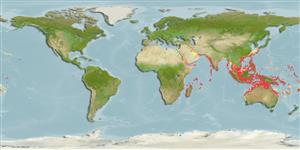
marien; brak water rifbewoner; standvastig; diepte 10 - 90 m (Ref. 6390). Tropical; 32°N - 35°S, 24°E - 167°W
Indo-West Pacific: widespread, from the Red Sea, Arabian (Persian) Gulf, and East Africa to the Ryukyus and Tonga.
Lengte bij maturiteit / Grootte / Gewicht / Leeftijd
Maturiteit: Lm 24.1, range 18 - ? cm
Max length : 52.0 cm TL mannelijk / geslacht onbekend; (Ref. 1020); common length : 40.0 cm TL mannelijk / geslacht onbekend; (Ref. 5450); max. gerapporteerde leeftijd: 19 Jaren (Ref. 42001)
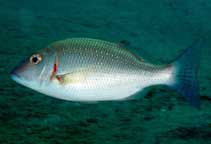
Dorsale stekels (totaal) : 10; Dorsale zachte stralen (totaal) : 9; Anale stekels: 3; Anale zachte stralen: 8. This species is distinguished by the following characters: body moderately deep, its depth 2.5-2.8 times in standard length; head length 0.9-1 times in body depth, 2.6-3 times in SL, dorsal profile near eye nearly straight; snout moderately short, its length about 1.9-2.4 times in HL, measured without the lip the snout is 0.8-1 times in cheek height, its dorsal profile nearly straight, snout angle relative to upper jaw between 60° and 70°; interorbital space convex; posterior nostril an oblong longitudinal opening, closer to orbit than anterior nostril; eye situated close to or far removed from dorsal profile, its length 3.3-4.8 times in HL; cheek not high, its height 2.4-3.1 times in HL; lateral teeth in jaws rounded often with conical tips, or molars often with tubercles; outer surface of maxilla with a longitudinal ridge; D X,9 with the 4th dorsal-fin spine usually the longest, its length 2.4-3.4 times in body depth; A III,8 soft rays, the first soft ray usually the longest, its length almost equal to or shorter than length of base of soft-rayed portion of anal fin and 1-1.2 times in length of entire anal-fin base; pectoral-fin rays 13; pelvic-fin membranes between rays closest to body without dense melanophores; cheek without scales; 46-47 lateral-line scales usually; 5 ½ scale rows between lateral line and base of middle dorsal-fin spines; 15- 16 scale rows in transverse series between origin of anal fin and lateral line; usually 15 rows in lower series of scales around caudal peduncle; 4-9 scales in supratemporal patch; inner surface of pectoral-fin base densely covered with scales, with a few scales, or naked; posterior angle of operculum fully scaly. Colour of body greenish or grey, shading to white below, centers of scales on upper sides often white; posterior margin of opercle and sometimes base of pectoral fins red; pectoral fins white, yellow, or pinkish; pelvic and anal fins white to orange; dorsal fin white and orange mottled with a reddish margin; caudal fin mottled orange or reddish (Ref. 114226).
Body shape (shape guide): fusiform / normal; Cross section: oval.
Inhabits sandy bottoms in coastal areas, deep lagoons and near coral reefs (Ref. 30573). Juveniles and small adults commonly in loose aggregations over seagrass beds, mangrove swamps and shallow sandy areas while adults are generally solitary in deeper waters. Feeds primarily on crustaceans and mollusks but echinoderms, polychaetes and fishes are also consumed in considerable quantities (Ref. 2295). A protogynous hermaphrodite (Ref. 55367). Caught primarily by handline, traps, trawls, beach seines, and gill nets. Marketed mostly fresh (Ref. 68703).
A monandric species (Ref. 55367). Length at sex change = 30.8 cm TL (Ref. 55367). Also Ref. 103751.
Carpenter, K.E. and G.R. Allen, 1989. FAO Species Catalogue. Vol. 9. Emperor fishes and large-eye breams of the world (family Lethrinidae). An annotated and illustrated catalogue of lethrinid species known to date. FAO Fish. Synop. 125(9):118 p. Rome: FAO. (Ref. 2295)
Status op de Rode Lijst van het IUCN (Ref. 130435: Version 2025-2 (Global))
Gevaar voor de mens
Harmless
Gebruik door de mens
Visserij: van groot commercieel belang
Tools
Speciale rapporten
Download XML
Internetbronnen
Schattingen op basis van modellen
Gewenste temperatuur (Ref.
123201): 24.6 - 29, mean 28 °C (based on 1436 cells).
Fylogenetische diversiteitsindex (Ref.
82804): PD
50 = 0.5000 [Uniqueness, from 0.5 = low to 2.0 = high].
Bayesian length-weight: a=0.01445 (0.01221 - 0.01710), b=2.97 (2.93 - 3.01), in cm total length, based on LWR estimates for this species (Ref.
93245).
Trofisch niveau (Ref.
69278): 3.9 ±0.2 se; based on diet studies.
Weerstandsvermogen (Ref.
120179): Gemiddeld, minimale populatieverdubbelingstijd 1,4-4,4 jaar (K=0.17-0.27; tm=2-3.8; tmax=15).
Prior r = 0.73, 95% CL = 0.48 - 1.10, Based on 3 data-limited stock assessments.
Kwetsbaarheid van de visserij (Ref.
59153): Low vulnerability (23 of 100).
🛈
Kwetsbaarheid voor het klimaat (Ref.
125649): High to very high vulnerability (75 of 100).
🛈
Voedingsstoffen (Ref.
124155): Calcium = 46.4 [31.1, 75.0] mg/100g; Iron = 0.907 [0.565, 1.423] mg/100g; Protein = 20.6 [18.1, 22.9] %; Omega3 = 0.155 [0.104, 0.226] g/100g; Selenium = 49.1 [27.2, 92.6] μg/100g; VitaminA = 20.5 [4.1, 122.7] μg/100g; Zinc = 2.25 [1.60, 2.99] mg/100g (wet weight);