>
Eupercaria/misc (Various families in series Eupercaria) >
Lethrinidae (Emperors or scavengers) > Lethrininae
Etymology: Lethrinus: Greek, lethrinia, a fish pertaining to genus Pagellus.
More on authors: Alleyne & Macleay.
Miljö: miljö / Klimatzon / djupintervall / distributionsområde
Ekologi
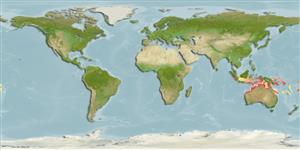
marina; brackvatten revassocierade; ej vandrande; djupintervall 5 - 35 m (Ref. 90102). Tropical; 3°S - 23°S
Western Pacific: southern Indonesia, northern Australia, Papua New Guinea and the Solomon Islands. There has been considerable confusion in the use of names for this species. In recent literature it is referred to as Lethrinus fraenatus (a junior synonym of Lethrinus nebulosus) or Lethrinus fletus (a junior synonym of Lethrinus laticaudis).
Storlek / Vikt / Ålder
Könsmognad: Lm ? range ? - ? cm
Max length : 56.0 cm TL hane/ej könsbestämd; (Ref. 2295); common length : 35.0 cm TL hane/ej könsbestämd; (Ref. 2295)
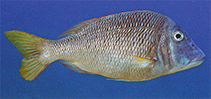
Taggstrålar i ryggfenan (totalt) : 10; Mjukstrålar i ryggfenan (totalt) : 9; Taggstrålar i analfenan: 3; Mjukstrålar i analfenan: 8. Cheek without scales; the inner base of pectoral fins densely covered with scales. Body is tan, brown or yellow with scattered irregular blotches; head brown or yellow with blue dots on cheeks and short blue stripes radiating in front and behind the eye, sometimes a number of blue cross stripes between the eyes; fines pale or yellow, the vertical fins are mottled.
Body shape (shape guide): fusiform / normal; Cross section: oval.
Juveniles found in seagrass beds and mangrove swamps. Adults found over coral reefs. Often in schools (Ref. 9710). Feeds mainly on crustaceans and fishes. Considered a good food fish. Marketed fresh (Ref. 9775).
Livscykel och parningsbeteende
Könsmognad | Reproduktion | Lek | Ägg | Fekunditet | Larver
Carpenter, K.E. and G.R. Allen, 1989. FAO Species Catalogue. Vol. 9. Emperor fishes and large-eye breams of the world (family Lethrinidae). An annotated and illustrated catalogue of lethrinid species known to date. FAO Fish. Synop. 125(9):118 p. Rome: FAO. (Ref. 2295)
Status på IUCN:s rödlista (Ref. 130435: Version 2025-2 (Global))
Hot mot människor
Harmless
Mänskliga användningsområden
Fiskeri: kommersiell; sportfisk: ja
Verktyg
Särskilda rapporter
Ladda ner XML
Internet-källor
Uppskattningar baserade på modeller
Önskad temperatur (Ref.
123201): 26.3 - 28.8, mean 27.7 °C (based on 242 cells).
Index för fylogenetisk mångfald (Ref.
82804): PD
50 = 0.5000 [Uniqueness, from 0.5 = low to 2.0 = high].
Bayesian length-weight: a=0.01445 (0.00683 - 0.03057), b=2.98 (2.81 - 3.15), in cm total length, based on LWR estimates for this Genus-body shape (Ref.
93245).
Trofisk nivå (Ref.
69278): 4.5 ±0.8 se; based on diet studies.
Resiliens (Ref.
120179): Mellan, lägsta populationsfördubblingstid 1,4-4,4 år (Preliminary K or Fecundity.).
Sårbarhet i fisket (Ref.
59153): Moderate vulnerability (42 of 100).
🛈
Näringsämnen (Ref.
124155): Calcium = 36.6 [23.6, 61.2] mg/100g; Iron = 0.797 [0.506, 1.323] mg/100g; Protein = 20.6 [18.0, 22.8] %; Omega3 = 0.139 [0.091, 0.215] g/100g; Selenium = 33.4 [18.0, 60.4] μg/100g; VitaminA = 54.5 [11.0, 309.5] μg/100g; Zinc = 1.93 [1.34, 2.67] mg/100g (wet weight);