>
Eupercaria/misc (Various families in series Eupercaria) >
Lethrinidae (Emperors or scavengers) > Lethrininae
Etymology: Lethrinus: Greek, lethrinia, a fish pertaining to genus Pagellus.
More on author: Valenciennes.
Environnement : milieu / zone climatique / profondeur / gamme de distribution
Écologie
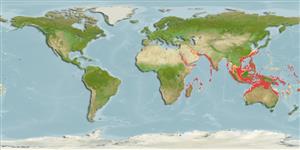
marin récifal; non migrateur; profondeur 1 - 150 m (Ref. 4369). Tropical; 30°N - 35°S, 24°E - 173°W
Indo-West Pacific: Red Sea and East Africa to the Ryukyu Islands and New Caledonia. Recently reported from Tonga (Ref. 53797). Also reported from French Polynesian islands (Ref. 4795) but this is a misidentification of Lethrinus rubrioperculatus (Ref. 2295).
Taille / Poids / Âge
Maturité: Lm ? range ? - ? cm
Max length : 20.0 cm TL mâle / non sexé; (Ref. 2295); âge max. reporté: 15 années (Ref. 2290)
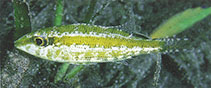
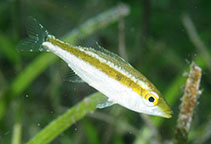
Épines dorsales (Total) : 10; Rayons mous dorsaux (Total) : 9; Épines anales: 3; Rayons mous anaux: 8. Body is brown and gray (usually green, Ref. 48635), becoming lighter ventrally, with scattered irregular dark spots. Often there are two dark bands below the eye, one at the lower rim or the opercle and one at the corner of the mouth. The fins are generally light or translucent; the caudal fin is light and dark striped.
Body shape (shape guide): fusiform / normal; Cross section: oval.
Inhabits sandy and weedy areas near coral reefs, solitarily or in groups (Ref. 30573, 90102), where it is well camouflaged and usually swims in the cover of the substrate (Ref. 48635). Juveniles sometimes abundant in shallow, weedy areas (Ref. 4369). Solitary or in small groups (Ref. 90102). Feeds on small benthic invertebrates (Ref. 30573). A protogynous hermaphrodite (Ref. 55367). Flesh of large individuals is esteemed (Ref. 4369).
Cycle de vie et comportement reproducteur
Maturité | Reproduction | Frai | Œufs | Fécondité | Larves
A monandric species (Ref. 55367). Length at sex change = 29.1 cm TL (Ref. 55367). Also Ref. 103751.
Carpenter, K.E. and G.R. Allen, 1989. FAO Species Catalogue. Vol. 9. Emperor fishes and large-eye breams of the world (family Lethrinidae). An annotated and illustrated catalogue of lethrinid species known to date. FAO Fish. Synop. 125(9):118 p. Rome: FAO. (Ref. 2295)
Statut dans la liste rouge de l'IUCN (Ref. 130435: Version 2025-2 (Global))
Menace pour l'homme
Harmless
Utilisations par l'homme
Pêcheries: intérêt commercial mineur
Outils
Articles particuliers
Télécharger en XML
Sources Internet
Estimations basées sur des modèles
Température préférée (Réf.
123201): 24.2 - 29, mean 27.9 °C (based on 1950 cells).
Indice de diversité phylogénétique (Réf.
82804): PD
50 = 0.5000 [Uniqueness, from 0.5 = low to 2.0 = high].
Bayesian length-weight: a=0.01445 (0.00683 - 0.03057), b=2.98 (2.81 - 3.15), in cm total length, based on LWR estimates for this Genus-body shape (Ref.
93245).
Niveau trophique (Réf.
69278): 3.8 ±0.0 se; based on diet studies.
Generation time: 2.2 ( na - na) years. Estimated as median ln(3)/K based on 1
growth studies.
Résilience (Réf.
120179): Milieu, temps minimum de doublement de population : 1,4 à 4,4 années (K=0.49; tmax=15).
Vulnérabilité de la pêche (Ref.
59153): Low vulnerability (10 of 100).
🛈
Nutriments (Ref.
124155): Calcium = 68.3 [47.0, 105.2] mg/100g; Iron = 0.968 [0.647, 1.427] mg/100g; Protein = 20 [17, 22] %; Omega3 = 0.168 [0.114, 0.243] g/100g; Selenium = 40.8 [25.8, 68.1] μg/100g; VitaminA = 49.5 [10.5, 270.8] μg/100g; Zinc = 2.54 [1.99, 3.27] mg/100g (wet weight); based on
nutrient studies.