分類 / 名前
共通名の | 類義語 | Catalog of Fishes(部類, 種) | ITIS | CoL | WoRMS | Cloffa
>
Eupercaria/misc (Various families in series Eupercaria) >
Lethrinidae (Emperors or scavengers) > Lethrininae
Etymology: Lethrinus: Greek, lethrinia, a fish pertaining to genus Pagellus.
More on author: Forsskål.
環境:環境 / 気候帯 / 深さの範囲 / 分布範囲
生態学
海; 汽水性の 関連する礁; 移住性ではない; 深さの範囲 10 - 75 m (Ref. 2295). Tropical; 34°N - 34°S, 25°E - 170°W
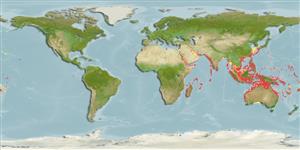
Indo-West Pacific: Red Sea, Persian Gulf and East Africa to southern Japan and Samoa. According to a genetic study (Ref. 28017), Lethrinus nebulosus and Lethrinus choerorynchus are two distinct species in Western Australia.
初回成熟時の長さ / サイズ / 重さ / 年齢
成熟: Lm 38.8, range 41 - ? cm
Max length : 87.0 cm TL オス/雌雄の選別がない; (Ref. 47613); common length : 70.0 cm TL オス/雌雄の選別がない; (Ref. 5450); 最大公表体重: 8.4 kg (Ref. 40637); 最大記録サイズ: 28 年 (Ref. 92312)
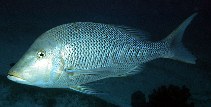
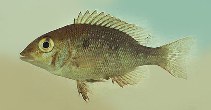
背面の脊椎 (合計) : 10; 背鰭 (合計) : 9; 肛門の骨: 3; 臀鰭: 8. This species is distinguished by the following characters: body moderately deep, its depth 2.5-2.9 times in standard length; head length 0.9-1 times in body depth, 2.6-3.1 times in SL, dorsal profile near eye nearly straight, or in large individuals, distinctly concave; snout moderately long, its length about 1.8-2.4 times in HL, measured without the lip the snout is 0.8-1 times in cheek height, its dorsal profile nearly straight or concave, snout angle relative to upper jaw between 50° and 68°; interorbital space usually convex; posterior nostril an oblong longitudinal opening, closer to orbit than anterior nostril or, about halfway between orbit and anterior nostril eye not close to dorsal profile except in small individuals, its length 3.6-5.9 times in HL; cheek moderately high, its height 2.4-3 times in HL; lateral teeth in jaws rounded with points or molars that often have tubercles; outer surface of maxilla smooth or with a longitudinal ridge; D X, 9 with the 4th or 5th dorsal-fin spine usually the longest, its length 2.7-3.6 times in body depth; A III,8 with the first soft ray usually the longest, its length almost equal to or slightly shorter than length of base of soft-rayed portion of anal fin and 1.3-1.6 times in length of entire anal-fin base; pectoral-fin rays 13; pelvic-fin membranes between rays closest to body usually with dense melanophores; cheek without scales; 46-48 lateral-line scales; 5 ½ scale rows between lateral line and base of middle dorsal-fin spines; 16-17 scale rows in transverse series between origin of anal fin and lateral line; usually 15 rows in lower series of scales around caudal peduncle; 5-9 scales in supratemporal patch; inner surface of pectoral-fin base densely covered with scales; posterior angle of operculum fully scaly. Colour of body yellowish or bronze, lighter below, centers of many scales with a white or light blue spot, sometimes irregular dark indistinct bars on sides and a square black blotch above pectoral fins bordering below lateral line; 3 blue streaks or series of blue spots radiating forward and ventrally from eye; fins whitish or yellowish, pelvic fins dusky, edge of dorsal fin reddish. Juveniles variable with blotches or stripe and changes with habitat (Ref. 114226).
Body shape (shape guide): fusiform / normal; Cross section: oval.
Inhabit coral reefs, coralline lagoons, seagrass beds, mangrove swamps, flat sand bottoms, and coastal rock areas. Adults solitary or in small schools; juveniles form large schools in shallow, sheltered sandy areas, also harbors where seagrasses, algae or sponge habitats are found at various depths. Feed on echinoderms, mollusks and crustaceans, and to some extent on polychaetes and fish. The reproductive nature of spangled emperors is uncertain, although they also may be protogynous hermaphrodites (Ref. 27260, 55367). However, recent study classified juvenile hermaphroditism for this species wherein transition from ovary to testis occurs before ovarian maturation, hence, no true sex-reversal in the sense of protogynous hermaphroditism is observed (Ref. 107020). May have a coppery or iodine taste or smell in the Indian Ocean (Ref. 2295, 11888). It has been shown that this species can survive for long periods in salinities as low as 10 parts per thousand and therefore it is a potential estuarine aquaculture species (Ref. 2295). Taken by handline, traps, trawls, seines, and gill nets. Marketed mostly fresh. Very important commercial and sport fish in some countries (Ref. 68703).
ライフサイクルと交尾行動
成熟 | 繁殖 | 放精 | 卵 | 生産力 | 幼生
The reproductive nature of spangled emperors is uncertain,. Though they also may be protogynous hermaphrodites (Ref. 27260), a study on the Great Barrier Reef (Ref. 27264) found no clear evidence of sex change in spangled emperors within the size range 17-54 cm (Ref. 6390). Gonochorism is inferred for this species as sizes of males and females overlapped and male gonad morphology is typical of secondarily derived testes (Ref. 103751). Recent study classified juvenile hermaphroditism for this species wherein transition from ovary to testis occurs before ovarian maturation, hence, no true sex-reversal is observed (Ref. 107020).
In the aquarium, pursuit of a female with a slightly swollen abdomen by a male signifies the start of mating. The male uses its mouth to bump and push the female's abdomen. Then eggs and sperm are released at the water surface (Ref. 58706).
Carpenter, K.E. and G.R. Allen, 1989. FAO Species Catalogue. Vol. 9. Emperor fishes and large-eye breams of the world (family Lethrinidae). An annotated and illustrated catalogue of lethrinid species known to date. FAO Fish. Synop. 125(9):118 p. Rome: FAO. (Ref. 2295)
IUCNのレッドリストの状況は (Ref. 130435: Version 2025-2 (Global))
人間に対する脅威
Reports of ciguatera poisoning (Ref. 31637)
人間の用途
水産業: 高い商業の; 水産養殖: 商業; ゲームフィッシュ: はい
用具
特記事項
XMLをダウンロードして下さい
インターネットの情報源
モデルに基づく推定値
好ましい温度 (参照
123201): 24.2 - 29, mean 28 °C (based on 1314 cells).
系統多様性指数 (参照
82804): PD
50 = 0.5000 [Uniqueness, from 0.5 = low to 2.0 = high].
Bayesian length-weight: a=0.01660 (0.01407 - 0.01958), b=2.98 (2.94 - 3.02), in cm total length, based on LWR estimates for this species (Ref.
93245).
栄養段階 (参照
69278): 3.8 ±0.2 se; based on diet studies.
Generation time: 5.8 (5.0 - 7.3) years. Estimated as median ln(3)/K based on 25
growth studies.
回復力 (参照
120179): 低い, 4.5年~14年の倍増期間の最小個体群 (K=0.09-0.16; tm=4-9; tmax=27).
Prior r = 0.28, 95% CL = 0.19 - 0.42, Based on 10 data-limited stock assessments.
漁業の脆弱性 (Ref.
59153): High vulnerability (57 of 100).
🛈
気候脆弱性 (Ref.
125649): High to very high vulnerability (71 of 100).
🛈
栄養素 (Ref.
124155): Calcium = 29.1 [19.9, 41.8] mg/100g; Iron = 0.698 [0.455, 1.043] mg/100g; Protein = 20.5 [18.0, 22.8] %; Omega3 = 0.132 [0.094, 0.181] g/100g; Selenium = 47.9 [28.7, 81.0] μg/100g; VitaminA = 22.4 [4.6, 124.8] μg/100g; Zinc = 2.06 [1.50, 2.66] mg/100g (wet weight); based on
nutrient studies.