Environnement : milieu / zone climatique / profondeur / gamme de distribution
Écologie
marin récifal; non migrateur; profondeur 15 - 80 m (Ref. 2295). Tropical; 35°N - 9°S
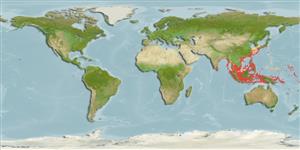
Indo-West Pacific: southern Japan to the Indo-Malaysian region, probably eastward to India. Has often been confused w/ the young of Gymnocranius grandoculis, hence its distributional limits are somewhat obscure. Records of Gymnocranius griseus from the Western Indian Ocean probably pertain to Gymnocranius grandoculis.
Taille / Poids / Âge
Maturité: Lm ? range ? - ? cm
Max length : 35.0 cm TL mâle / non sexé; (Ref. 2295); common length : 25.0 cm TL mâle / non sexé; (Ref. 2295)
Épines dorsales (Total) : 10; Rayons mous dorsaux (Total) : 9 - 10; Épines anales: 3; Rayons mous anaux: 9 - 10.
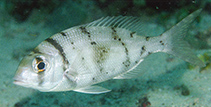
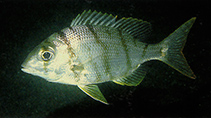
Body shape (shape guide): fusiform / normal; Cross section: oval.
In sheltered coastal bays and sand and mud slopes in depths over 20 m (Ref. 48635); also in coastal trawling grounds. Juveniles sometimes in shallow estuaries on algae reefs (Ref. 48635). Sometimes forms schools. Feeds on bottom-living invertebrates. Sexually mature upon reaching 15-17 cm SL. Sometimes caught with handlines and marketed dried (Ref. 9775) or fresh. In Hong Kong live fish markets (Ref. 27253).
Cycle de vie et comportement reproducteur
Maturité | Reproduction | Frai | Œufs | Fécondité | Larves
Carpenter, K.E. and G.R. Allen, 1989. FAO Species Catalogue. Vol. 9. Emperor fishes and large-eye breams of the world (family Lethrinidae). An annotated and illustrated catalogue of lethrinid species known to date. FAO Fish. Synop. 125(9):118 p. Rome: FAO. (Ref. 2295)
Statut dans la liste rouge de l'IUCN (Ref. 130435: Version 2025-2 (Global))
Menace pour l'homme
Harmless
Utilisations par l'homme
Pêcheries: commercial; pêche sportive: oui
Outils
Articles particuliers
Télécharger en XML
Sources Internet
Estimations basées sur des modèles
Température préférée (Réf.
123201): 24.2 - 28.8, mean 28.1 °C (based on 445 cells).
Indice de diversité phylogénétique (Réf.
82804): PD
50 = 0.5005 [Uniqueness, from 0.5 = low to 2.0 = high].
Bayesian length-weight: a=0.01698 (0.00720 - 0.04003), b=2.98 (2.79 - 3.17), in cm total length, based on LWR estimates for this (Sub)family-body shape (Ref.
93245).
Niveau trophique (Réf.
69278): 3.2 ±0.44 se; based on food items.
Generation time: 5.0 ( na - na) years. Estimated as median ln(3)/K based on 1
growth studies.
Résilience (Réf.
120179): Milieu, temps minimum de doublement de population : 1,4 à 4,4 années (K=0.22).
Vulnérabilité de la pêche (Ref.
59153): Moderate vulnerability (38 of 100).
🛈
Nutriments (Ref.
124155): Calcium = 39.5 [20.2, 69.1] mg/100g; Iron = 0.519 [0.283, 0.847] mg/100g; Protein = 19.2 [17.2, 21.2] %; Omega3 = 0.128 [0.075, 0.187] g/100g; Selenium = 34.9 [21.0, 60.2] μg/100g; VitaminA = 81.5 [24.8, 238.5] μg/100g; Zinc = 1.32 [0.94, 1.79] mg/100g (wet weight);