>
Eupercaria/misc (Various families in series Eupercaria) >
Lethrinidae (Emperors or scavengers) > Monotaxinae
Etymology: Gnathodentex: Greek, gnathos = jaw + latin, dens, dentis = teeth (Ref. 45335).
More on author: Lacepède.
Environnement : milieu / zone climatique / profondeur / gamme de distribution
Écologie
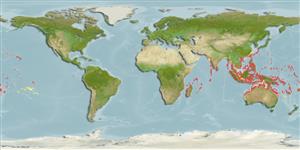
marin récifal; non migrateur; profondeur 0 - 30 m (Ref. 9710). Tropical; 30°N - 30°S, 31°E - 134°W
Indo-Pacific: East Africa to the Tuamoto Islands (excluding the Hawaiian Islands), north to Japan, south to Australia. Recently reported from Norfolk Island (Ref. 8880).
Taille / Poids / Âge
Maturité: Lm ? range ? - ? cm
Max length : 42.3 cm FL mâle / non sexé; (Ref. 125599); common length : 20.0 cm TL mâle / non sexé; (Ref. 2295); poids max. publié: 2.1 kg (Ref. 125599)
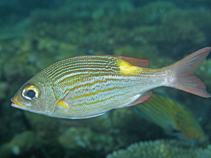
Épines dorsales (Total) : 10; Rayons mous dorsaux (Total) : 10; Épines anales: 3; Rayons mous anaux: 8 - 10.
Body shape (shape guide): fusiform / normal; Cross section: oval.
Inhabits subtidal reef flats, lagoons, and seaward reefs (Ref. 9710). May be solitary or in groups (Ref. 90102). Sometimes forms aggregations of about a hundred or more individuals. Feeds at night on benthic invertebrates like crabs and gastropods, occasionally on small fish. Usually marketed fresh. Minimum depth reported taken from Ref. 128797.
Cycle de vie et comportement reproducteur
Maturité | Reproduction | Frai | Œufs | Fécondité | Larves
Carpenter, K.E. and G.R. Allen, 1989. FAO Species Catalogue. Vol. 9. Emperor fishes and large-eye breams of the world (family Lethrinidae). An annotated and illustrated catalogue of lethrinid species known to date. FAO Fish. Synop. 125(9):118 p. Rome: FAO. (Ref. 2295)
Statut dans la liste rouge de l'IUCN (Ref. 130435: Version 2025-2 (Global))
Menace pour l'homme
Reports of ciguatera poisoning (Ref. 4690)
Utilisations par l'homme
Pêcheries: commercial
Outils
Articles particuliers
Télécharger en XML
Sources Internet
Estimations basées sur des modèles
Température préférée (Réf.
123201): 24.9 - 29.3, mean 28.4 °C (based on 3356 cells).
Indice de diversité phylogénétique (Réf.
82804): PD
50 = 1.0000 [Uniqueness, from 0.5 = low to 2.0 = high].
Bayesian length-weight: a=0.01585 (0.00978 - 0.02569), b=3.02 (2.89 - 3.15), in cm total length, based on LWR estimates for this species & (Sub)family-body (Ref.
93245).
Niveau trophique (Réf.
69278): 3.7 ±0.57 se; based on food items.
Résilience (Réf.
120179): Milieu, temps minimum de doublement de population : 1,4 à 4,4 années (Preliminary K or Fecundity.).
Vulnérabilité de la pêche (Ref.
59153): Moderate vulnerability (37 of 100).
🛈
Nutriments (Ref.
124155): Calcium = 49.5 [23.9, 92.4] mg/100g; Iron = 0.562 [0.301, 0.922] mg/100g; Protein = 19.6 [17.6, 21.6] %; Omega3 = 0.132 [0.076, 0.196] g/100g; Selenium = 27.4 [16.5, 48.6] μg/100g; VitaminA = 82 [26, 239] μg/100g; Zinc = 1.22 [0.87, 1.70] mg/100g (wet weight);