>
Syngnathiformes (Pipefishes and seahorses) >
Syngnathidae (Pipefishes and seahorses) > Syngnathinae
Etymology: Hippocampus: Greek, ippos = horse + Greek,kampe = curvature (Ref. 45335).
More on author: Linnaeus.
Περιβάλλον: περιβάλλον / κλιματική ζώνη / εύρος βάθους / εύρος διανομής
Οικολογία
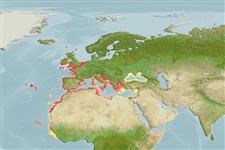
Θαλασσινό(ά) βενθικό(ς); μη μεταναστευτικό(ά); εύρος βάθους 0 - 60 m (Ref. 52034). Subtropical; 53°N - 7°N, 32°W - 42°E
Eastern Atlantic: British Isles to Guinea and the Mediterranean Sea
Μήκος κατά την πρώτη ωρίμανση / Μέγεθος / Βάρος / Ηλικία
Γεννητική Ωρίμανση: Lm 7.7 range ? - ? cm
Max length : 15.0 cm TL αρσενικό/απροσδιόριστο; (Ref. 6733)
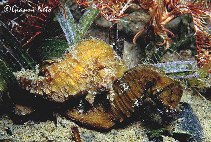
Ραχιαίες άκανθες (συνολικά) : 0; Μαλακές ραχιαίες ακτίνες (συνολικά) : 16 - 19. Description (based on 35 specimens): Adult height: 7.0-13.0cm. Rings: 11 + 37 (35-38). Snout length: 3.0 (2.8-3.4) in head length. Dorsal fin rays: 17 (16-19) covering 2+1 rings. Pectoral fin rays: 14 (13-15). Coronet: narrow, ridge-like and joined smoothly to nape of neck, or wedge-shaped (front narrow, back high and broad); some specimens with very large angular coronet (especially specimens from West Africa). Spines: low, very low in adults. Other distinctive characters: very short snout (usually less than 1/3 head length) that is slightly upward-bent; prominent eye spine. Color pattern: mottled brown to yellow, to maroon and rust (Refs. 52034, 89230); also orange, purple or black; sometimes with tiny white dots, but these do not coalesce into thick horizontal wavy lines as in H. guttulatus.
Body shape (shape guide): other.
Inhabits dense, complex habitats as well as patchy, relatively open and sparse habitats of coastal areas. Found on soft bottoms amongst rocks and algae (Ref. 6733), on sparsely vegetated areas, and in coastal lagoons with strong oceanic influences (Refs. 52034, 89230). Mimics the green or yellow coloration of plants allowing it to hide among the vegetation. This ability likely plays a role in seahorse feeding strategy and in predator avoidance (Ref. 52034). Makes limited daily movements within very restricted home ranges (0.7-18.1 m2) (Refs. 52034, 89256). May over-winter in deeper water. (Ref. 53712). Adult dispersal over large distances is probably caused by strong wave action during storms or when it anchors itself to floating debris (Ref. 52034).
Is thought to live for 3-5 years (Ref. 52034). Because of its short generation time and multiple breeding cycles during each spawning season, resilience is thought to be high. However, in tropical areas where seagrass beds are regularly exploited for other species of seahorses for the aquarium trade, traditional medicine, etc., populations have been quickly eradicated (Ref. 89253). Feeds on small prey and organic debris. Has been reared in captivity (Ref. 35416). Minimum depth reported taken from Ref. 128812.
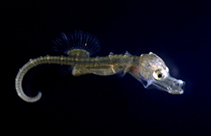
Ovoviviparous, with the female depositing eggs into the male brood pouch. During the mating season, mature males and females have been observed to change hue, i.e., become brighter, when greeting, courting, or mating (Ref. 88171). Newly hatched young are thought to have a planktonic stage that lasts at least eight weeks (Refs. 47822, 52034).
Lourie, S.A., R.A. Pollom and S.J. Foster, 2016. A global revision of the seahorses Hippocampus Rafinesque 1810 (Actinopterygii: Syngnathiformes): taxonomy and biogeography with recommendations for further research. Zootaxa 4146(1):1-66. (Ref. 115213)
Κατάσταση Κόκκινου Καταλόγου IUCN (Ref. 130435: Version 2025-2 (Global))
Απειλή για τον άνθρωπο
Harmless
Ανθρώπινες χρήσεις
αλιεία: περιορισμένης εμπορικότητας; Ενυδρείο: show Ενυδρείο
Εργαλεία
Ειδικές εκθέσεις
Λήψη XML
Διαδικτυακές πηγές
Εκτιμήσεις βάσει μοντέλων
Προτιμώμενη θερμοκρασία (Αναφ.
123201): 10.9 - 26.5, mean 17.8 °C (based on 304 cells).
Δείκτης φυλογενετικής ποικιλότητας (Αναφ.
82804): PD
50 = 0.5000 [Uniqueness, from 0.5 = low to 2.0 = high].
Bayesian length-weight: a=0.00282 (0.00164 - 0.00484), b=2.96 (2.80 - 3.12), in cm total length, based on LWR estimates for this species & (Sub)family-body (Ref.
93245).
Τροφικό Επίπεδο (Αναφ.
69278): 3.2 ±0.4 se; based on diet studies.
Generation time: 1.2 ( na - na) years. Estimated as median ln(3)/K based on 1
growth studies.
Ελαστικότητα (Αναφ.
120179): Υψηλό, ελάχιστος χρόνος για διπλασιασμό πληθυσμού < 15 μήνες (tm=0.3-0.4).
Ευπάθεια στην αλιεία (Ref.
59153): Low vulnerability (15 of 100).
🛈
Θρεπτικά συστατικά (Ref.
124155): Calcium = 191 [40, 725] mg/100g; Iron = 2.42 [0.86, 8.49] mg/100g; Protein = 3.35 [0.00, 7.22] %; Omega3 = 0.283 [0.105, 0.775] g/100g; Selenium = 31.1 [6.5, 111.1] μg/100g; VitaminA = 5.88 [1.39, 24.14] μg/100g; Zinc = 1.46 [0.69, 2.95] mg/100g (wet weight);