>
Syngnathiformes (Pipefishes and seahorses) >
Syngnathidae (Pipefishes and seahorses) > Syngnathinae
Etymology: Syngnathus: Greek, syn, symphysis = grown together + Greek, gnathos = jaw (Ref. 45335).
More on author: Linnaeus.
Ambiente: milieu / zona climatica / distribuzione batimetrica / gamma di distribuzione
Ecologia
marino; salmastro demersale; non migratori (Ref. 88171); distribuzione batimetrica 0 - 110 m (Ref. 4281), usually 3 - 15 m (Ref. 126547). Subtropical; 71°N - 35°S, 19°W - 42°E
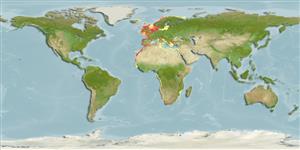
Eastern Atlantic: Norway, Faroes and British Isles to Western Sahara, Senegambia, and from Namibia to Cape of Good Hope and northward to the coast of Zululand in the western Indian Ocean (Ref. 4127). Also throughout the Mediterranean, Aegean and Black seas. Despite literature records, occurrence in the Indo-Pacific outside South African waters lacks conclusive evidence (Ref. 4281).
Lunghezza alla prima maturità / Dimensione / Peso / Età
Maturità: Lm 16.3, range 7 - 25.6 cm
Max length : 50.0 cm TL maschio/sesso non determinato; (Ref. 35388)
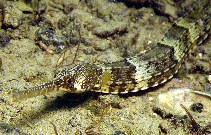
Spine dorsali (totale) : 0; Raggi dorsali molli (totale) : 33 - 42; Spine anali: 0; Raggi anali molli: 3. Light greenish to dark brown in color with variable markings (Ref. 4281). Snout cylindrical, equal to or less than eye diameter. With 18 - 19 body rings between head and dorsal fin (Ref. 35388). The snake pipefish (Entelurus aequoreus) is distinguished by the lack of pectoral and anal fins (Ref. 88171). An elongated bump on top of head behind eye (Ref. 59043).
Body shape (shape guide): eel-like.
Found in coastal and estuarine waters to depths of at least 110 m (Ref. 4281); on sand, mud and rough bottoms. Common amongst algae and eel-grass (Zostera) (Refs. 4146, 6733, 88187). Feeds mainly on small crustaceans (Ref. 85544). It is parasitised by the monogenean Gyrodactylus eyipayipi on the body surface, inside the flute and male brood pouch (Ref. 124059).
Ovoviviparous; reproducing on average 3 times each year (Ref. 89328). Several females depositing partial clutches to a male’s brood pouch under the tail (Refs. 205, 31201). Up to 400 eggs may be found in a single pouch (Ref. 89329). Brooding males occur mainly between May and July (Refs. 31201, 58137). During the breeding season, both males and females were observed to remain low amongst the seagrass in one meadow (Ref. 31201). Gestation period lasts about 5 weeks and size at birth is 1.7- 3.5 cm (Refs. 58137, 88187, 89330). Aquarium experiments have shown that new born young are benthic, remaining close to the bottom Ref. 89330).
Dawson, C.E., 1986. Syngnathidae. p. 628-639. In P.J.P. Whitehead, M.-L. Bauchot, J.-C. Hureau, J. Nielsen and E. Tortonese (eds.) Fishes of the North-eastern Atlantic and the Mediterranean. Volume 2. Unesco, Paris. (Ref. 6733)
Stato della Lista Rossa IUCN (Ref. 130435: Version 2025-2 (Global))
Minaccia per l'uomo
Harmless
Usi umani
Pesca: di nessun interesse; Acquario: Commerciale
Strumenti
Rapporti speciali
Scarica XML
Fonti Internet
Stime basate su modelli
Temperatura preferita (Fonte Biblio.
123201): 10.3 - 22.6, mean 17.7 °C (based on 934 cells).
Indice di diversità filogenetica (Fonte Biblio.
82804): PD
50 = 0.5000 [Uniqueness, from 0.5 = low to 2.0 = high].
Bayesian length-weight: a=0.00025 (0.00019 - 0.00032), b=3.22 (3.16 - 3.28), in cm total length, based on LWR estimates for this species (Ref.
93245).
Livello trofico (Fonte Biblio.
69278): 3.3 ±0.2 se; based on diet studies.
Resilienza (Fonte Biblio.
120179): Medio, tempo minimo di raddoppiamento della popolazione 1.4 - 4.4 anni (Fec=200).
Vulnerabilità della pesca (Ref.
59153): Moderate vulnerability (40 of 100).
🛈
Nutrienti (Ref.
124155): Calcium = 54.6 [12.4, 151.7] mg/100g; Iron = 1.02 [0.39, 3.52] mg/100g; Protein = 3.7 [0.1, 7.5] %; Omega3 = 0.286 [0.130, 0.629] g/100g; Selenium = 22.8 [5.1, 60.3] μg/100g; VitaminA = 9.35 [4.02, 21.44] μg/100g; Zinc = 0.838 [0.431, 1.605] mg/100g (wet weight);