>
Eupercaria/misc (Various families in series Eupercaria) >
Lutjanidae (Snappers) > Lutjaninae
Etymology: Lutjanus: Malay, ikan lutjan, name of a fish.
More on author: Cuvier.
Milieu: milieu / Klimaatzone / Diepte / verspreidingsgebied
Ecologie
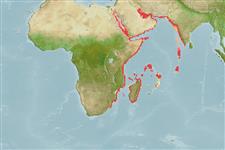
marien rifbewoner; diepte 9 - 150 m (Ref. 9710). Tropical; 31°N - 30°S, 30°E - 77°E (Ref. 55)
Western Indian Ocean: Red Sea east to the Arabian Sea and south to Natal, South Africa. Records of this species from the eastern Indian Ocean and the Western Central Pacific are probably misidentifications of Lutjanus malabaricus (Ref. 55). Has been misidentified as Lutjanus coccineus by recent authors.
Lengte bij maturiteit / Grootte / Gewicht / Leeftijd
Maturiteit: Lm 51.1, range 50 - 60 cm
Max length : 100.0 cm TL mannelijk / geslacht onbekend; (Ref. 9710); common length : 70.0 cm TL mannelijk / geslacht onbekend; (Ref. 5450); max. gepubliceerd gewicht: 23.0 kg (Ref. 469); max. gerapporteerde leeftijd: 13 Jaren (Ref. 1488)
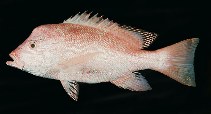
Dorsale stekels (totaal) : 10; Dorsale zachte stralen (totaal) : 13 - 14; Anale stekels: 3; Anale zachte stralen: 8 - 9. Dorsal profile of head angular, snout steeply sloped. Preorbital bone broad, with horizontal grooves behind and below the eye. Anterior and posterior nostrils widely spaced. Preopercular notch and knob poorly developed. Scale rows on back rising obliquely above lateral line. Juveniles with a broad brown bar from upper jaw to beginning of dorsal fin and a series of reddish horizontal lines on sides.
Body shape (shape guide): fusiform / normal; Cross section: oval.
Adults inhabit coral and rocky reefs to depths of at least 100 m (Ref. 30573). Off South Africa they display a preference for slightly silty, turbid regions in the vicinity of sometimes shallow, offshore banks. Captured mainly at night on coral banks off Mafia Island (Tanzania) in 9 to 12 m and off Zanzibar in about 75 m. They are active at night feeding over sandy or rubble bottoms (Ref. 9710). Maximum depth reported taken from Ref. 9773.
Allen, G.R., 1985. FAO Species Catalogue. Vol. 6. Snappers of the world. An annotated and illustrated catalogue of lutjanid species known to date. FAO Fish. Synop. 125(6):208 p. Rome: FAO. (Ref. 55)
Status op de Rode Lijst van het IUCN (Ref. 130435: Version 2025-2 (Global))
Gevaar voor de mens
Harmless
Gebruik door de mens
Visserij: van groot commercieel belang; sportvis: ja; Aquarium: Commercieel
Tools
Speciale rapporten
Download XML
Internetbronnen
Schattingen op basis van modellen
Gewenste temperatuur (Ref.
123201): 23.4 - 29.2, mean 26.8 °C (based on 328 cells).
Fylogenetische diversiteitsindex (Ref.
82804): PD
50 = 0.5000 [Uniqueness, from 0.5 = low to 2.0 = high].
Bayesian length-weight: a=0.01445 (0.00833 - 0.02507), b=2.96 (2.82 - 3.10), in cm total length, based on LWR estimates for this species & Genus-body shape (Ref.
93245).
Trofisch niveau (Ref.
69278): 4.5 ±0.7 se; based on diet studies.
Weerstandsvermogen (Ref.
120179): laag, minimale populatieverdubbelingstijd 4,5-14 jaar (K=0.14-0.24; tm=2.5-6; tmax=13).
Kwetsbaarheid van de visserij (Ref.
59153): Moderate vulnerability (39 of 100).
🛈
Voedingsstoffen (Ref.
124155): Calcium = 20.1 [12.1, 30.3] mg/100g; Iron = 0.298 [0.190, 0.484] mg/100g; Protein = 18.6 [17.1, 19.9] %; Omega3 = 0.126 [0.086, 0.186] g/100g; Selenium = 74.5 [44.1, 119.9] μg/100g; VitaminA = 173 [33, 695] μg/100g; Zinc = 0.311 [0.241, 0.432] mg/100g (wet weight);