>
Gobiiformes (Gobies) >
Microdesmidae (Wormfishes) > Ptereleotrinae
Etymology: Parioglossus: Greek, pareia = jaw + Greek, glossa = tongue (Ref. 45335).
Eponymy: Edward Henry Rainford (1853–1938) was an English-born Australian amateur naturalist who was viticulturist at the Queensland Agricultural Department, based at Bowen in north Queensland. He collected specimens of fauna and flora for the Australian Museum. (Ref. 128868), visit book page.
Environnement : milieu / zone climatique / profondeur / gamme de distribution
Écologie
marin; saumâtre récifal; profondeur 0 - 5 m (Ref. 86942). Tropical; 25°N - 28°S
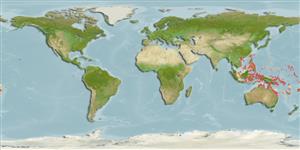
Western Pacific: Philippines to Papua New Guinea, north to Yaeyama Islands, south to Queensland, Australia; including Palau and Pohnpei (Caroline Islands) in Micronesia and New Caledonia (Ref. 11889).
Taille / Poids / Âge
Maturité: Lm ? range ? - ? cm
Max length : 4.5 cm TL mâle / non sexé; (Ref. 90102)
Description synthétique
Clés d'identification | Morphologie | Morphométrie
Épines dorsales (Total) : 5 - 7; Rayons mous dorsaux (Total) : 14 - 17; Épines anales: 1; Rayons mous anaux: 14 - 16.
Body shape (shape guide): elongated.
Form schools among mangroves and in coastal inlets, associate with P. formosus (Ref. 1602).
Cycle de vie et comportement reproducteur
Maturité | Reproduction | Frai | Œufs | Fécondité | Larves
Myers, R.F., 1991. Micronesian reef fishes. Second Ed. Coral Graphics, Barrigada, Guam. 298 p. (Ref. 1602)
Statut dans la liste rouge de l'IUCN (Ref. 130435: Version 2025-2 (Global))
Menace pour l'homme
Harmless
Utilisations par l'homme
Outils
Articles particuliers
Télécharger en XML
Sources Internet
Estimations basées sur des modèles
Température préférée (Réf.
123201): 25.2 - 29.3, mean 28.5 °C (based on 1481 cells).
Indice de diversité phylogénétique (Réf.
82804): PD
50 = 0.5000 [Uniqueness, from 0.5 = low to 2.0 = high].
Bayesian length-weight: a=0.00389 (0.00180 - 0.00842), b=3.12 (2.94 - 3.30), in cm total length, based on all LWR estimates for this body shape (Ref.
93245).
Niveau trophique (Réf.
69278): 3.2 ±0.4 se; based on size and trophs of closest relatives
Vulnérabilité de la pêche (Ref.
59153): Low vulnerability (10 of 100).
🛈