>
Gobiiformes (Gobies) >
Microdesmidae (Wormfishes) > Ptereleotrinae
Etymology: Parioglossus: Greek, pareia = jaw + Greek, glossa = tongue (Ref. 45335).
More on author: Smith.
Umwelt: Milieu / Klimazone / Tiefenbereich / Verbreitungsgebiet
Ökologie
seewasser; brackwasser riff-verbunden; tiefenbereich 0 - 15 m (Ref. 48444). Tropical; 25°N - 24°S
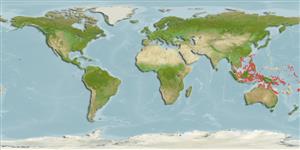
Western Pacific: Gulf of Thailand to Fiji, north to Yayaema Islands, south to northwestern Australia and the southern Great Barrier Reef.
Größe / Gewicht / Alter
Geschlechtsreife: Lm ? range ? - ? cm
Max length : 4.5 cm SL Männchen/unbestimmt; (Ref. 48637)
Kurzbeschreibung
Bestimmungsschlüssel | Morphologie | Morphometrie
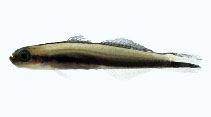
Rückenflossenstacheln (insgesamt) : 6 - 7; Rückenflossenweichstrahlen (insgesamt) : 13 - 15; Afterflossenstacheln: 1; Afterflossenweichstrahlen: 13 - 15.
Body shape (shape guide): elongated.
Occurs in shallow coastal reefs and mangrove-lined inlets. Hovers in schools among branching corals or mangroves to a depth of about 4 meters.
Lebenszyklus und Paarungsverhalten
Geschlechtsreife | Fortpflanzung | Ablaichen | Eier | Fruchtbarkeit | Larven
Myers, R.F., 1991. Micronesian reef fishes. Second Ed. Coral Graphics, Barrigada, Guam. 298 p. (Ref. 1602)
IUCN Rote Liste Status (Ref. 130435: Version 2025-2 (Global))
Bedrohung für Menschen
Harmless
Nutzung durch Menschen
Tools
Zusatzinformationen
Download XML
Internet Quellen
Schätzungen auf der Grundlage von Modellen
Bevorzugte Temperatur (Ref.
123201): 26.1 - 29.3, mean 28.7 °C (based on 1701 cells).
Phylogenetischer Diversitätsindex (Ref.
82804): PD
50 = 0.5000 [Uniqueness, from 0.5 = low to 2.0 = high].
Bayesian length-weight: a=0.00389 (0.00180 - 0.00842), b=3.12 (2.94 - 3.30), in cm total length, based on all LWR estimates for this body shape (Ref.
93245).
Trophische Ebene (Ref.
69278): 3.2 ±0.4 se; based on size and trophs of closest relatives
Anfälligkeit der Fischerei (Ref.
59153): Low vulnerability (10 of 100).
🛈