>
Cypriniformes (Carps) >
Cyprinidae (Minnows or carps) > Labeoninae
Etymology: Labiobarbus: Latin, labium = lip + Latin, barbus = barbel (Ref. 45335).
Entorno: milieu / zona climática / rango de profundidad / gama de distribución
Ecología
; agua dulce bentopelágico. Tropical
Asia: known only from the type locality, the Kinabatangan and Segama river basins in Sabah, northeastern Borneo, Malaysia.
Tamaño / Peso / Edad
Madurez: Lm ? range ? - ? cm
Max length : 22.0 cm SL macho / no sexado; (Ref. 34011)
Descripción breve
Claves de identificación | Morfología | Morfometría
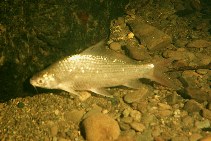
Vértebra: 35 - 36. Distinguished from all other species of Labiobarbus by having only 18-22 branched dorsal rays (versus 22 or more), a very thick head and body, and a very steep dorsal profile, concave at the nape. Maxillary barbel very long, extending posteriorly well beyond eye (Ref. 7424).
Body shape (shape guide): fusiform / normal.
Ciclo vital y comportamiento de apareamiento
Madurez | Reproducción | Puesta | Huevos | Fecundidad | Larva
Roberts, T.R., 1993. Systematic revision of the Southeast Asian cyprinid fish genus Labiobarbus (Teleostei: Cyprinidae). Raffles Bull. Zool. 41(2):315-329. (Ref. 7424)
Situación en la Lista Roja de la UICN (Ref. 130435: Version 2025-2 (Global))
Amenaza para el ser humano
Harmless
Usos humanos
Herramientas
Informes especiales
Descargar XML
Fuentes de Internet
Estimaciones basadas en modelos
Índice de diversidad filogenética (Referencia
82804): PD
50 = 0.5020 [Uniqueness, from 0.5 = low to 2.0 = high].
Bayesian length-weight: a=0.00933 (0.00435 - 0.02001), b=3.05 (2.88 - 3.22), in cm total length, based on LWR estimates for this (Sub)family-body shape (Ref.
93245).
Nivel trófico (Referencia
69278): 2.4 ±0.1 se; based on size and trophs of closest relatives
Resiliencia (Referencia
120179): Medio, población duplicada en un tiempo mínimo de 1.4-4.4 años (Preliminary K or Fecundity.).
Vulnerabilidad pesquera (Ref.
59153): Low vulnerability (17 of 100).
🛈