>
Scombriformes (Mackerels) >
Caristiidae (Manefishes)
Etymology: Platyberyx: Name from the Greek 'platy' meaning flat and Beryx, a genus of beryciform fishes; opalescens: Name from Latin 'opalus', for an opal.
Lingkungan: lingkungan / zona iklim / kisaran kedalaman / jangkauan distribusi
Ekologi
laut batipelagis; kisaran kedalaman 1 - 2000 m (Ref. 94277). Subtropical; 55°N - 27°S (Ref. 94277)
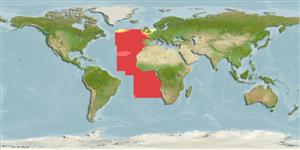
Eastern Atlantic.
Ukuran / Berat / umur
Kematangan: Lm ? range ? - ? cm
Max length : 13.9 cm SL jantan/; (Ref. 126117); Berat maksimum terpublikasi: 123.00 g (Ref. 126117)
deskripsi pendek
Kunci identifiaksi (pengenalan) | Morfologi | Morfometrik
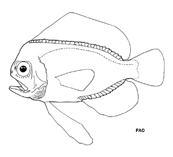
duri punggung lunak (Keseluruhan (total)) : 27 - 29; Sirip dubur lunak: 17 - 19; vertebrata, bertulang belakang: 32 - 34. This species is distinguished by the following characters: differs from P. paucus by having greater number of dorsal-fin rays (27-29 vs. 24-25), anal-fin rays (17-19 vs. 15-16), pectoral-fin rays (17-20 vs. 16-17), and vertebrae (32-34 vs. 31); from P. andriashevi by having fewer dorsal-fin rays (27-29 vs. 31-37), anal-fin rays (17-19 vs. 19-22), and vertebrae (32-34 vs. 36-39); and from both species by caudal-fin morphology (ventral caudal spur absent, procurrent rays cylindrical vs. ventral caudal spur present, procurrent rays flattened, bladelike); differs from P. rhyton and P. mauli by morphometrics, including a deeper body (52-64% vs. 45-52% SL), longer head length (>38% vs. <34% SL), longer prepectoral length (>39% vs. <36% SL), and smaller mouth (upper jaw extending approximately to mid-orbit vs. posterior margin of orbit); differs from P. pietschi by caudal-fin morphology (ventral caudal spur absent, procurrent rays cylindrical vs. ventral caudal spur present, procurrent rays flattened, bladelike) and gill-raker morphology (bristles on gill rakers small and uniform vs. small bristles and large spikes on rakers) (Ref. 94277).
Body shape (shape guide): short and / or deep; Cross section: compressed.
Max. length of a photo (Rógvi Mouritsen, pers. comm., 2003).
Stevenson, D.E. and C.P. Kenaley, 2013. Revision of the manefish genera Caristius and Platyberyx (Teleostei: Percomorpha: Caristiidae), with description of five new species. Copeia 2013(3):415-434. (Ref. 94277)
Status IUCN Red List (Ref. 130435: Version 2025-2 (Global))
ancaman kepada manusia
Harmless
penggunaan manusia
Alat, peralatan
laporan khas
muat turun XML
Sumber internet
Estimasi berdasarkan model
Suhu yang disukai (Acuan
123201): 6.3 - 11.6, mean 10.4 °C (based on 91 cells).
Indeks keanekaragaman filogenetik (Acuan
82804): PD
50 = 0.5156 [Uniqueness, from 0.5 = low to 2.0 = high].
Bayesian length-weight: a=0.02455 (0.00947 - 0.06362), b=3.00 (2.77 - 3.23), in cm total length, based on LWR estimates for this (Sub)family-body shape (Ref.
93245).
Tingkat Trofik (Acuan
69278): 3.5 ±0.5 se; based on size and trophs of closest relatives
Kerentanan Penangkapan Ikan (Ref.
59153): Low vulnerability (10 of 100).
🛈