Klassifizierung / Names
Namen | Synonyme | Catalog of Fishes(Gattung, Arten) | ITIS | CoL | WoRMS | Cloffa
Umwelt: Milieu / Klimazone / Tiefenbereich / Verbreitungsgebiet
Ökologie
seewasser; brackwasser demersal; katadrom (Ref. 138297); tiefenbereich 10 - ? m (Ref. 3573). Subtropical; 47°N - 29°N, 11°W - 42°E
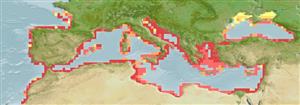
Eastern Atlantic: Mediterranean Sea, the Black Sea, Sea of Azov and Atlantic coasts from Morocco to France. Introduced to Iran and is now naturally occurring in the Caspian Sea basin (Ref. 50218).
Länge bei der ersten Reifung / Größe / Gewicht / Alter
Geschlechtsreife: Lm 21.3, range 17 - 22 cm
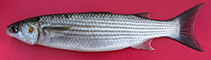
Max length : 40.0 cm SL Männchen/unbestimmt; (Ref. 3397); common length : 30.0 cm TL Männchen/unbestimmt; (Ref. 9987); max. veröff. Alter: 4 Jahre (Ref. 27030)
Adults usually in schools inhabit coastal waters (Ref. 3573); sometimes in lagoons and estuaries (Ref. 59043). Juveniles around 2.0 cm SL move to coastal lagoons and estuaries in summer and autumn (Ref. 59043). Adults are herbivorous feeding on algae and vegetal detritus while juveniles feed on zooplankton until about 3 cm SL, then on benthic organisms until 5 cm SL (Ref. 9987, 59043). Reproduce in summer (Ref. 2804). Oviparous, eggs are pelagic and non-adhesive (Ref. 205). Utilized for roe, but also fresh, smoked and frozen (Ref. 9987).
Thomson, J.M., 1986. Mugilidae. p. 344-349. In J. Daget, J.-P. Gosse and D.F.E. Thys van den Audenaerde (eds.) Check-list of the freshwater fishes of Africa (CLOFFA). ISNB, Brussels, MRAC; Tervuren; and ORSTOM, Paris. Vol. 2. (Ref. 3573)
IUCN Rote Liste Status (Ref. 130435: Version 2025-2 (Global))
Bedrohung für Menschen
Harmless
Nutzung durch Menschen
Fischereien: weniger kommerziell; Aquakultur: kommerziell
Tools
Zusatzinformationen
Download XML
Internet Quellen
Schätzungen auf der Grundlage von Modellen
Bevorzugte Temperatur (Ref.
123201): 14.4 - 21.5, mean 18.4 °C (based on 154 cells).
Phylogenetischer Diversitätsindex (Ref.
82804): PD
50 = 0.5010 [Uniqueness, from 0.5 = low to 2.0 = high].
Bayesian length-weight: a=0.01023 (0.00854 - 0.01227), b=2.96 (2.93 - 2.99), in cm total length, based on LWR estimates for this species (Ref.
93245).
Trophische Ebene (Ref.
69278): 2.9 ±0.38 se; based on food items.
Generation time: 4.2 (3.4 - 5.5) years. Estimated as median ln(3)/K based on 12
growth studies.
Widerstandsfähigkeit (Ref.
120179): mittel, Verdopplung der Population dauert 1,4 - 4,4 Jahre. (K=0.1-0.3; tm=2-4; tmax=4).
Anfälligkeit der Fischerei (Ref.
59153): Moderate to high vulnerability (45 of 100).
🛈
Klimaanfälligkeit (Ref.
125649): Moderate vulnerability (39 of 100).
🛈
Nährstoffe (Ref.
124155): Calcium = 51.7 [14.1, 292.9] mg/100g; Iron = 0.722 [0.360, 1.278] mg/100g; Protein = 18.4 [17.0, 20.0] %; Omega3 = 0.73 [0.33, 1.67] g/100g; Selenium = 6.96 [2.86, 17.33] μg/100g; VitaminA = 12.3 [3.7, 38.5] μg/100g; Zinc = 0.621 [0.386, 0.987] mg/100g (wet weight); based on
nutrient studies.