Milieu: milieu / Klimaatzone / Diepte / verspreidingsgebied
Ecologie
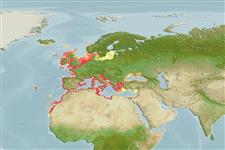
marien; zoet water; brak water pelagic-neritic; katadroom (Ref. 138280); diepte 10 - 20 m (Ref. 7399). Temperate; 64°N - 20°N, 26°W - 42°E
Eastern Atlantic: British Isles, North Sea, Norwegian Sea, Barents Sea, Bay of Biscay, Western Africa and offshore islands including the Canaries, Azores and Madeira; the Mediterranean and Black Sea. Introduced to the Caspian Sea.
Lengte bij maturiteit / Grootte / Gewicht / Leeftijd
Maturiteit: Lm 34.0 range ? - ? cm
Max length : 61.0 cm FL mannelijk / geslacht onbekend; (Ref. 117745); common length : 30.0 cm SL mannelijk / geslacht onbekend; (Ref. 7399); max. gepubliceerd gewicht: 2.5 kg (Ref. 117745)
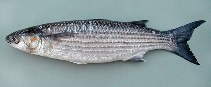
Dorsale stekels (totaal) : 5; Dorsale zachte stralen (totaal) : 7 - 9; Anale stekels: 3. Longer pectoral fins, lack of black spot at the pectoral fin base. Golden spot present in gill cover (Ref. 35388).
Body shape (shape guide): fusiform / normal.
Adults are neritic usually in schools, entering lagoons and lower estuaries (Ref. 7399); rarely entering freshwater (Ref. 3573, 59043). Juveniles move to coastal lagoons and estuaries in winter and especially in spring (Ref. 59043). They feed on small benthic organisms, detritus, and occasionally on insects and plankton (Ref. 2804). Juveniles feed only on zooplankton (Ref. 59043). Reproduction takes place in the sea, from July to November. Oviparous, eggs are pelagic and non-adhesive (Ref. 205). Minimum size allowed for fishing is 20 cm. The quality of the flesh is variable (Ref. 30578).
Juveniles move to coastal lagoons and estuaries in winter and especially in spring (Ref. 59043).
Thomson, J.M., 1986. Mugilidae. p. 344-349. In J. Daget, J.-P. Gosse and D.F.E. Thys van den Audenaerde (eds.) Check-list of the freshwater fishes of Africa (CLOFFA). ISNB, Brussels, MRAC; Tervuren; and ORSTOM, Paris. Vol. 2. (Ref. 3573)
Status op de Rode Lijst van het IUCN (Ref. 130435: Version 2025-2 (Global))
Gevaar voor de mens
Harmless
Gebruik door de mens
Visserij: commercieel; Aquacultuur: commercieel
Tools
Speciale rapporten
Download XML
Internetbronnen
Schattingen op basis van modellen
Gewenste temperatuur (Ref.
123201): 9.7 - 20.7, mean 11.9 °C (based on 344 cells).
Fylogenetische diversiteitsindex (Ref.
82804): PD
50 = 0.5010 [Uniqueness, from 0.5 = low to 2.0 = high].
Bayesian length-weight: a=0.01023 (0.00857 - 0.01221), b=2.95 (2.92 - 2.98), in cm total length, based on LWR estimates for this species (Ref.
93245).
Trofisch niveau (Ref.
69278): 2.8 ±0.33 se; based on food items.
Generation time: 5.5 (3.7 - 6.9) years. Estimated as median ln(3)/K based on 31
growth studies.
Weerstandsvermogen (Ref.
120179): Gemiddeld, minimale populatieverdubbelingstijd 1,4-4,4 jaar (K=0.14-0.34; tm=3-4; tmax=8; Fec>10,000).
Prior r = 0.77, 95% CL = 0.51 - 1.16, Based on 1 data-limited stock assessment.
Kwetsbaarheid van de visserij (Ref.
59153): Moderate vulnerability (36 of 100).
🛈
Kwetsbaarheid voor het klimaat (Ref.
125649): Low to moderate vulnerability (35 of 100).
🛈
Voedingsstoffen (Ref.
124155): Calcium = 15.9 [5.1, 136.9] mg/100g; Iron = 0.255 [0.151, 0.421] mg/100g; Protein = 18.2 [16.9, 19.7] %; Omega3 = 1.21 [0.47, 3.11] g/100g; Selenium = 2.88 [1.17, 7.25] μg/100g; VitaminA = 12.9 [3.4, 52.7] μg/100g; Zinc = 0.478 [0.334, 0.670] mg/100g (wet weight); based on
nutrient studies.