Classification / Noms
Noms communs | Synonymes | Catalog of Fishes(Genre, Espèce) | ITIS | CoL | WoRMS | Cloffa
Environnement : milieu / zone climatique / profondeur / gamme de distribution
Écologie
; eau douce démersal. Subtropical
Asia: Taiwan.
Taille / Poids / Âge
Maturité: Lm ? range ? - ? cm
Max length : 16.0 cm TL mâle / non sexé; (Ref. 6898)
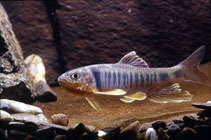
Rayons mous dorsaux (Total) : 10 - 11; Rayons mous anaux: 11 - 13; Vertèbres: 39 - 41. More than 48 (modally 50-54) scales on lateral line; 20-23 predorsal scales; 4+36-37 (= 40-41) vertebral count; maxillary extending to or beyond vertical midline of orbit in female; and opercle and ventral side of head orange-red to pink-red in adult male (Ref. 95038).
Body shape (shape guide): fusiform / normal.
Cycle de vie et comportement reproducteur
Maturité | Reproduction | Frai | Œufs | Fécondité | Larves
Mating behavior: Usually begins with fighting among males. Only one mates. Females rest on sandy ground and the male presses her belly. This makes the female tilt with her anus closer to the male. The male vibrates and releases the sperm. Subordinate males often join the spawning pair, perhaps to release their sperm.
Chen, I.-S., J.-H. Wu and Huang S.-P., 2009. The taxonomy and phylogeny of the cyprinid genus Opsariichthys Bleeker (Teleostei: Cyprinidae) from Taiwan, with description of a new species. Environ. Biol. Fishes 86:165-183. (Ref. 81910)
Statut dans la liste rouge de l'IUCN (Ref. 130435: Version 2025-2 (Global))
Menace pour l'homme
Harmless
Utilisations par l'homme
Outils
Articles particuliers
Télécharger en XML
Sources Internet
Estimations basées sur des modèles
Indice de diversité phylogénétique (Réf.
82804): PD
50 = 0.5000 [Uniqueness, from 0.5 = low to 2.0 = high].
Bayesian length-weight: a=0.00851 (0.00402 - 0.01800), b=3.09 (2.92 - 3.26), in cm total length, based on LWR estimates for this (Sub)family-body shape (Ref.
93245).
Niveau trophique (Réf.
69278): 3.2 ±0.4 se; based on size and trophs of closest relatives
Résilience (Réf.
120179): Milieu, temps minimum de doublement de population : 1,4 à 4,4 années (Fec = 712).
Vulnérabilité de la pêche (Ref.
59153): Low vulnerability (10 of 100).
🛈