>
Eupercaria/misc (Various families in series Eupercaria) >
Sciaenidae (Drums or croakers)
Etymology: Argyrosomus: Greek, argyros = silvered, silver + Greek, soma = body (Ref. 45335); inodorus: Name from the Latin 'inodorus' meaning without smell (first suspected of being a different species because it lacked the strong brassy/metallic smell that is typical of A. japonicus found in South African waters.
Milieu: milieu / Klimaatzone / Diepte / verspreidingsgebied
Ecologie
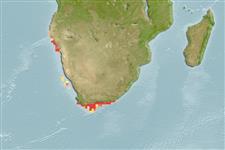
marien; brak water benthopelagisch; oceanodroom (Ref. 51243); diepte 1 - 100 m (Ref. 11025). Subtropical; 17°S - 38°S, 11°E - 29°E
Southeast Atlantic: Namibia southwards around the Cape of Good Hope and northwards at least as far as the Kei River in South Africa.
Lengte bij maturiteit / Grootte / Gewicht / Leeftijd
Maturiteit: Lm 34.4 range ? - ? cm
Max length : 145 cm TL mannelijk / geslacht onbekend; (Ref. 11025); common length : 115 cm TL mannelijk / geslacht onbekend; (Ref. 11025); max. gepubliceerd gewicht: 36.3 kg (Ref. 11025)
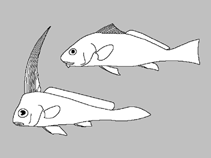
Dorsale stekels (totaal) : 11; Dorsale zachte stralen (totaal) : 25 - 29; Anale stekels: 2; Anale zachte stralen: 7 - 8; Wervels: 25. Swim bladder carrot-shaped with 31-42 arborescent appendages, the latero-anterior limb of appendages present throughout length of bladder; drumming muscles present only in males; urinary bladders rudimentary; sagitta elongate with pronounced bulge in posterior third of ventral margin; pectoral fin axillary fold naked; peritoneum unpigmented; anterior part of lateral line slightly curved.
Between the Kei River and Cape Agulhas, this species rarely enters estuaries or the surf zone, but becomes more abundant in the surf zone on the west coast of South Africa. Restricted to a depth of 1-20 m in Namibia, apparently due to anoxic conditions beyond this depth. Highly regarded as a table fish. Marketed mostly fresh, but sometimes frozen (Ref. 11025).
Griffiths, M.H. and P.C. Heemstra, 1995. A contribution to the taxonomy of the marine fish genus Argyrosomus (Perciformes: Sciaenidae), with descriptions of two new species from southern Africa. Ichthyol. Bull., J.L.B. Smith Inst. Ichthyol. No. 65, 40 p. (Ref. 11025)
Status op de Rode Lijst van het IUCN (Ref. 130435: Version 2025-2 (Global))
Gevaar voor de mens
Harmless
Gebruik door de mens
Visserij: commercieel; sportvis: ja
Tools
Speciale rapporten
Download XML
Internetbronnen
Schattingen op basis van modellen
Gewenste temperatuur (Ref.
123201): 13.9 - 21.7, mean 16.3 °C (based on 48 cells).
Fylogenetische diversiteitsindex (Ref.
82804): PD
50 = 0.5020 [Uniqueness, from 0.5 = low to 2.0 = high].
Bayesian length-weight: a=0.00832 (0.00488 - 0.01417), b=3.06 (2.92 - 3.20), in cm total length, based on LWR estimates for this species & (Sub)family-body (Ref.
93245).
Trofisch niveau (Ref.
69278): 4.2 ±0.67 se; based on food items.
Weerstandsvermogen (Ref.
120179): Gemiddeld, minimale populatieverdubbelingstijd 1,4-4,4 jaar (K=0.09-0.12; tm=1.3-2.4).
Prior r = 0.35, 95% CL = 0.23 - 0.52, Based on 2 full stock assessments.
Kwetsbaarheid van de visserij (Ref.
59153): High to very high vulnerability (68 of 100).
🛈
Voedingsstoffen (Ref.
124155): Calcium = 23.8 [8.7, 62.9] mg/100g; Iron = 0.459 [0.153, 1.330] mg/100g; Protein = 19.3 [17.3, 21.3] %; Omega3 = 0.299 [0.157, 0.522] g/100g; Selenium = 23.4 [7.6, 89.8] μg/100g; VitaminA = 17.9 [5.6, 58.4] μg/100g; Zinc = 0.592 [0.424, 0.858] mg/100g (wet weight);